The Five-Star Review Engine.
A steady stream of real Google reviews, without begging, buying, or breaking the rules.
- The exact moment to ask, and the word-for-word scripts
- What never to do: the rule-breakers that get reviews deleted
- Reply templates for great, lukewarm, and rough reviews
- The weekly Review Engine Checklist
The download link is headed to your inbox. Give it a minute or two, and check spam or promotions if it hides.
Instant delivery. No spam, unsubscribe anytime.
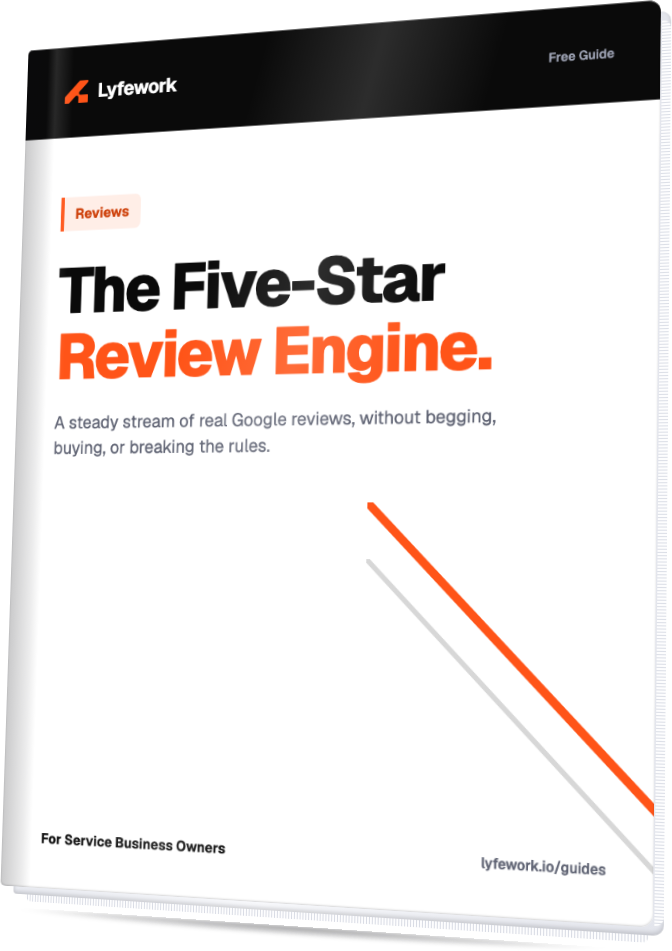
How a service business earns a steady stream of real Google reviews, without begging, buying, or breaking any rules.
Before someone calls you, they read your reviews. Before they trust your website, they check your star rating. And Google itself treats reviews, how many you have, how recent they are, and what they say, as a signal of whether you're worth showing to the next person who searches. Reviews aren't a nice-to-have anymore. They're one of the first things a buyer sees and one of the things Google weighs when deciding who shows up first.
And yet most businesses handle this badly. They ask once, months after the job is done, when the customer barely remembers who they hired. Or they never ask at all and just hope people remember on their own. Some get desperate and offer a discount for a review, which is against Google's rules and can get reviews removed or an account suspended. None of this is complicated to fix. It just needs a system.
Why Happy Customers Don't Review On Their Own
A customer who's thrilled with your work is not thinking about you five minutes after the job is done. They're thinking about dinner, about the next thing on their list, about their kid's soccer game. Leaving a review takes effort: find the business, find the review button, think of something to say, type it out. Most people will only push through that effort for two reasons: they're furious, or someone asked them at the right moment and made it easy.
That's the whole game. Happy customers don't withhold reviews on purpose. They just never get around to it unless you give them a clear, easy reason to do it now.
The Moment That Matters: Ask Right After The Win
Timing is almost everything. The best moment to ask is right after the customer feels the win, right after the job is finished, the problem is solved, or the result shows up. That's when gratitude is highest and the memory is freshest. Wait a week and the feeling fades. Wait a month and they've forgotten half of what you did.
A well-run system handles this automatically. The moment a job or appointment is marked complete, a short thank-you goes out first, then the review ask follows a couple hours to a day later, while the experience is still fresh. If nothing comes back, one polite follow-up goes out a couple days after that. No guilt, no repeated nagging, just one clean ask and one clean reminder.
For bigger wins, like a completed project rather than a single visit, the same idea plays out on a longer clock: a check-in on day one asking how it feels now that it's live, a follow-up a few days later with a couple of easy prompts in case they're not sure what to say, and a final no-pressure ask about a week after that. If they don't respond, the door stays open and the system moves on. That's it. No badgering.
How To Ask: Word For Word
The words matter less than people think, but having something ready beats fumbling in the moment. Here are scripts you can use as-is.
In person, right after you deliver the result:
"Hey, I'm really glad this worked out for you. If you have thirty seconds, would you mind leaving us a quick Google review? It genuinely helps other people find us. I can text you the link right now so it's one tap."
By text, sent within a day of the job finishing:
"Hi [Name], it's [Your Name] from [Business]. Glad we could get this sorted for you. If you have a minute, a quick Google review would mean a lot: [link]. Takes about 30 seconds. Thanks again for trusting us with it."
By email, if text isn't the right channel:
Subject: quick favor?
"Hi [Name], your project is done and I hope it's working out exactly how you hoped. If you have a couple minutes, a short Google review helps other people in your position see what to expect from us. Here's the link, it should take you straight to the review box: [link]. No pressure either way, and thanks again for the opportunity."
Notice what's missing: no ten-step instructions, no "click here, then click here." The link should drop the customer straight into the review box in one tap. Every extra step you add is a chance for them to give up.
What Never To Do
Google is specific about this, and breaking these rules can get your reviews deleted or your listing suspended entirely. Stay clear of all of it:
- Never pay for reviews. Not with cash, not with a gift card, not with a discount on their next visit. A review earned with a reward isn't honest proof anymore, and Google can detect and remove incentivized reviews.
- Never gate reviews. That's the trick where you ask "how was your experience?" first and only send happy customers to Google while quietly routing unhappy ones elsewhere. It's against Google's policies and it also means you're hiding real feedback instead of fixing it.
- Never write or buy fake reviews. Not from friends, not from a review-farm service, not from an employee posing as a customer. These get caught more often than people think, and once a business is flagged, real reviews get harder to trust too.
- Never ask everyone to review at once. A sudden spike looks unnatural and can trigger a review filter. Steady and spread out beats a burst.
The honest path is slower but it's the only one that holds up. A steady trickle of real reviews, collected the same way every time, is worth more than a fake pile that could vanish overnight.
Reply To Every Review, Including The Rough Ones
Replying matters almost as much as collecting. It shows future customers someone's actually running the business, and it shows Google the profile is active. Keep replies short and human.
For a great review:
"Thanks so much, [Name]. Really glad we could help with [specific thing they mentioned]. We appreciate you taking the time to write this."
For a mixed or lukewarm review:
"Thanks for the honest feedback, [Name]. We'd like to make this right, would you mind giving us a call at [number] so we can sort it out?"
For a negative review:
"[Name], sorry to hear this didn't go the way it should have. That's not the standard we hold ourselves to. Please reach out at [number] or [email] so we can fix it directly."
Never argue in public. Never get defensive. A calm, short reply to a bad review often does more for your reputation than ten good reviews, because it shows people how you handle problems, not just how you handle wins.
Put Your Reviews To Work
A review sitting on your profile is doing maybe a quarter of its job. The rest of the value comes from putting it in front of people at the moment they're deciding.
- On your site. Pull specific reviews, ones with a real detail in them, onto your homepage and service pages, not just a generic "great service" badge.
- In proposals. A short, specific quote from a customer who had the same problem your prospect has is worth more than any claim you make about yourself. Specific beats generic every time. "Great service, highly recommend" could describe any business on earth. A review that names the actual problem, what changed, and how long it took is the one that moves someone.
- In ads. A short real quote as a caption or overlay outperforms most stock claims, because it's a stranger vouching for you instead of you vouching for yourself.
The Review Engine Checklist
Run this every week and the reviews take care of themselves.
- Every job or appointment completed this week has a thank-you sent within a couple hours
- Every completed job has a review ask sent within 24 to 48 hours of the thank-you
- The review link is tested and goes straight to the review box in one tap
- Anyone who hasn't responded gets exactly one follow-up, no more
- Every new review, good or bad, gets a reply within 48 hours
- No review was ever paid for, discounted, or gated this week
- At least one strong new review is pulled onto the site or into a proposal
- Total review count and rating are checked against last week
Your Next Step
If you want to see exactly where your business stands right now, how many reviews you have, how fast you're replying, and how visible you actually are when someone searches, get a free scan at lyfework.io/audit. Or if you'd rather talk it through, book a call at lyfework.io/book.
Want this as a clean PDF for your team?
Send Me the Guide