
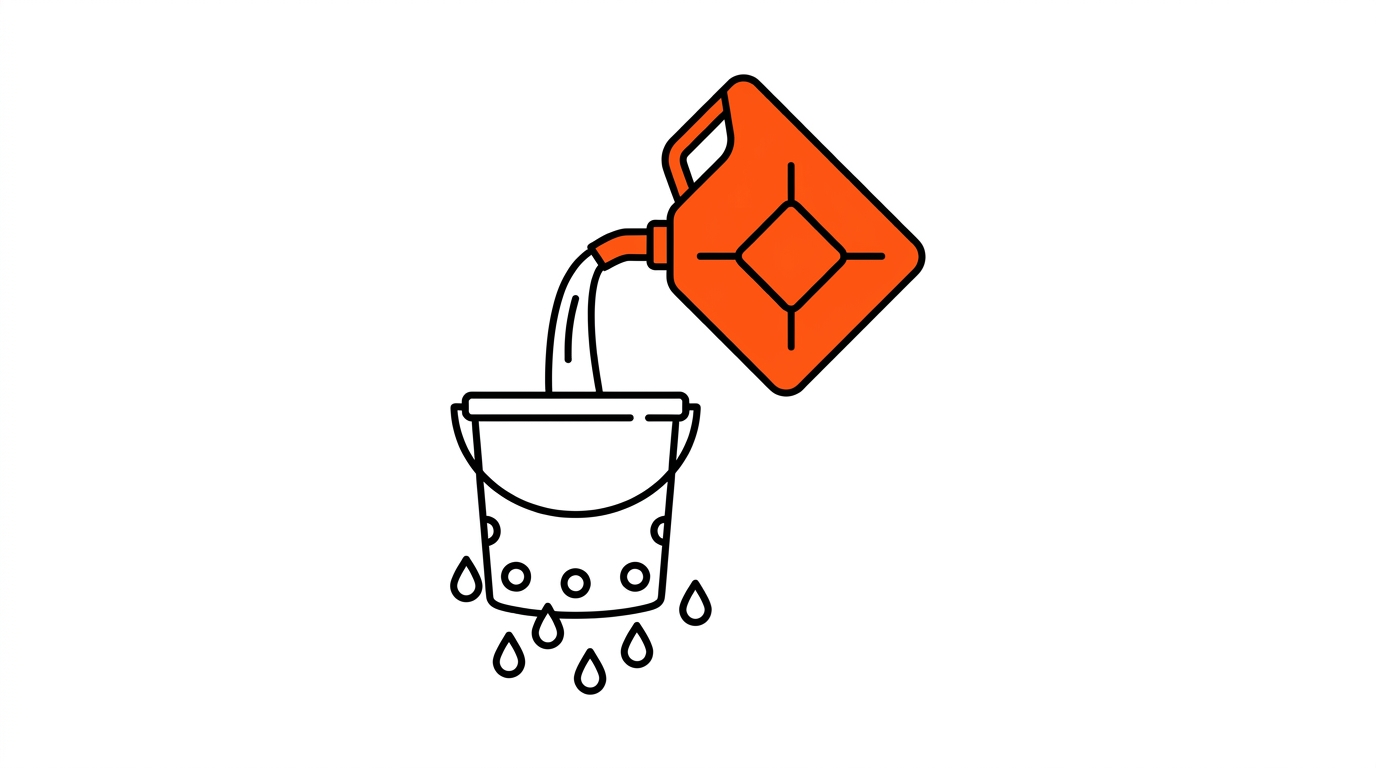
Your Google Ads aren't working because of what happens after the click, not what's inside the campaign. The ad delivered someone with buying intent to your door. What came next, a slow page, a phone that rang through to voicemail, a form inquiry that sat in an inbox for six hours, lost them. Google's job ends at the click. Everything after that is yours.
Every article you'll find on this topic goes through the same checklist: pause settings, bid strategy, keyword match types, landing page relevance. All of that matters. But those articles stop at the moment the click lands. None of them follow the lead past the form submit or the phone ring, and that's exactly where most service businesses are losing money.
The framework that makes this legible is in the three stages of demand: Generate (get found), Capture (turn visitors into leads), and Convert (turn leads into booked work). Ads operate at the Generate stage. When they "don't work," the failure is almost always at Capture or Convert. You're generating demand fine. It's just leaking out before it reaches you.
Why am I getting clicks but no calls?
Clicks without calls means one of two things: the page isn't converting visitors into callers, or calls are coming in and being missed. Both look identical from inside your Google Ads account because the campaign shows healthy click volume and you see nothing on the other side.
On the page side, the most common culprits aren't dramatic. The phone number isn't prominent above the fold on mobile. The page takes four seconds to load and visitors tap back. The headline talks about the company instead of the customer's problem. There's a contact form but no reason to believe anyone will respond today. Each of those is fixable, and none of them will show up in your campaign data.
On the call side, the data is more stark. Invoca's 2022 platform analysis found that 27% of calls to home services businesses go unanswered. A 2024 study by 411 Locals across 85 businesses in 58 industries found that only 37.8% of incoming calls were answered by a live person. That means for every three people who called directly from a local ad, roughly two either reached voicemail or got no answer at all.
Those aren't campaign problems. They're receiving system problems. And when you're paying for each click, a missed call isn't just a missed call. It's a paid lead you handed to whoever picked up second.
What is speed-to-lead, and why does it matter for ads?
Speed-to-lead is the time between when a lead comes in and when you make first contact. It matters because buying intent decays fast, and when someone found you through a paid ad, that decay happens even faster.
The original research on this came from a 2007 study by Dr. James Oldroyd at MIT and InsideSales.com, and it was republished with additional data by Harvard Business Review in 2011. The findings: responding within 5 minutes instead of 30 makes you 21 times more likely to qualify the lead. Those numbers are from the B2B world nearly 20 years ago, and they've held as a benchmark because the underlying behavior hasn't changed. What has changed is that the problem has gotten worse, not better.
More recent data is less encouraging. Blazeo's 2026 industry report found that 81.2% of companies that take longer than an hour to respond to a lead report losing leads as a result. A 2024 Hatch study of HVAC businesses found that 88% take longer than 5 minutes to reply, and the most common response time is one full day. And there's a gap between what businesses know they should do and what they actually do: the same Blazeo data shows 38% of business leaders say responding within 5 minutes is essential, and 38% of those same leaders fail to hit their own standard.
For a service business running paid traffic, slow response time is the fastest way to destroy ROI. You paid to get someone interested at a specific moment. Every hour you wait, that interest transfers to whoever does pick up.
What happens when you miss a call from a Google Ad?
You lose the lead and the click cost at the same time. And unlike a slow website (which you can fix and test), a missed call is silent. It doesn't appear in your campaign data as a failure. It just looks like a click that didn't convert.
The voicemail route is nearly always a dead end. Invoca's 2022 data shows fewer than 3% of callers who reach voicemail leave a message. The rest hang up and move on. For home services specifically, a caller with an urgent job (a plumbing issue, an HVAC failure in August, a tree on the fence) isn't going to leave a voicemail and wait. They're going to call the next number on the list.
Picture a roofing company running Google Ads for storm damage repairs. Every click costs real money. Calls come in during business hours, after hours, and on weekends. Housecall Pro's platform data, cited by Blazeo in 2026, shows that 41% of jobs on their platform are booked after hours, evenings and weekends. If the roofing company's phones are covered 9 to 5, Monday through Friday, more than 4 in 10 of their ad-driven inquiries are landing in a gap where no one is there to answer. That's not a campaign problem. That's a coverage problem.
A missed-call text-back system fixes the most acute version of this. It fires automatically within 60 seconds of a missed call, sends a text to the caller saying you saw their call and will follow up shortly, and creates a response channel that doesn't require the caller to try again. We build these for the businesses we work with, and the thing that stands out every time is how many calls were arriving after hours that the owner had no idea about. The gap between "calls we got" and "calls we know we got" is almost always larger than expected. The related read on exactly how this works is how missed-call text-back actually works.
How do you know if your Google Ads are actually making money?
Most businesses don't. The tracking gap is one of the quieter problems in small business paid search, and it makes it almost impossible to know whether to increase a budget, cut it, or redirect it entirely.
WordStream's research reviewing 500 small and mid-size AdWords accounts found that less than half had conversion tracking installed on their landing pages. That was published in 2013, and while the tools have gotten easier to use since then, the underlying behavior in local service businesses hasn't changed dramatically. Without conversion tracking, your campaign dashboard shows impressions, clicks, and cost. It does not show whether any of those clicks became customers. You're flying with no instruments.
The things that matter are fairly simple to define: how many people called from the ad, how many forms were filled out, how many of those turned into booked appointments, and what the average job value was. With those four numbers you can calculate a real cost-per-customer and compare it to what you're spending. Without them, you're either guessing or using click-through rate as a proxy for revenue, which it isn't.
One thing we check in every Demand Audit is whether basic call tracking and form conversion tracking are installed and firing correctly. The audit looks at the booking path, the response chain, and whether the tracking setup gives you a real picture of what's happening. More often than not, at least one of those is broken or missing entirely, and it makes every optimization decision downstream unreliable.
What is a booking path, and why does it matter for ad conversions?
A booking path is the route a visitor can take from your landing page to a confirmed appointment without talking to you first. It matters for ads specifically because the person who clicked your ad is interested right now. If they have to fill out a form, wait for a callback, and then schedule, you've introduced friction at the exact moment their intent is highest.
The question to ask about any page your ads are pointing to: can someone book a time with you from this page without making a phone call? If the answer is no, you're asking every high-intent visitor to take an extra step that some fraction of them won't take. For service businesses that can estimate job scope upfront (pressure washing, lawn care, cleaning, HVAC tune-ups), an online booking calendar on the landing page converts at meaningfully higher rates than a form-and-wait model.
For businesses where scope genuinely can't be determined without a conversation first (custom remodels, complex plumbing, legal work), the alternative is a tightly scoped contact form with a clear promise: "We call back within one business hour." That's a booking path too. It just requires the callback to actually happen on that schedule.
We check for a working booking path as a standard part of the Demand Audit because it's one of the highest-leverage Convert Demand fixes. You can have a perfectly structured campaign and a fast page. Without a clear next step that a visitor can take on their own, you're leaving the decision in their hands instead of guiding them through it.
When are Google Ads actually worth it?
Ads are worth it when the receiving system is ready for them. That's the honest answer, and it's the answer that every article about fixing your campaign settings misses.
The three-stage model makes this concrete. Ads live in the Generate Demand stage: they bring someone to your door. Whether that person books depends on Capture Demand (does the page convert visitors into leads?) and Convert Demand (do you contact those leads fast enough and have a path to book?). An ad campaign running into a broken Capture or Convert layer produces expensive clicks that go nowhere. The same campaign running into a working system produces a predictable cost-per-booked-job.
We have a standard we hold for ourselves before recommending paid traffic for any business: does the booking path work, does the follow-up fire within minutes, and is there real conversion tracking in place? We run that check on our own site first. Chloe, our AI receptionist, answers questions on lyfework.io in seconds. That's not a nice feature. It's the floor we hold to before we'd tell anyone to send paid traffic our way. If the site can't convert at 11pm on a Sunday, paid traffic at 11pm on a Sunday is waste.
Google Ads work for service businesses. The conversion rate benchmarks from WordStream's 2024 analysis (17,998 US-based campaigns) show averages ranging from 5.78% for business services to 12.96% for automotive repair. Those are real, achievable numbers. What sits behind those numbers is a receiving system that catches what the ad sends. The businesses at the high end of those ranges aren't running better campaigns than everyone else. They're running better operations underneath them.
If your campaigns are already running and not converting, the Demand Audit is where we'd start. It looks at the Convert Demand layer: booking path, call handling, follow-up speed, and tracking. It shows you exactly what's leaking and in what order to fix it. Once those are solid, ads become the accelerant they're supposed to be. For more on how the three stages connect, see the demand architecture overview and the deeper look at the Convert Demand layer specifically.