
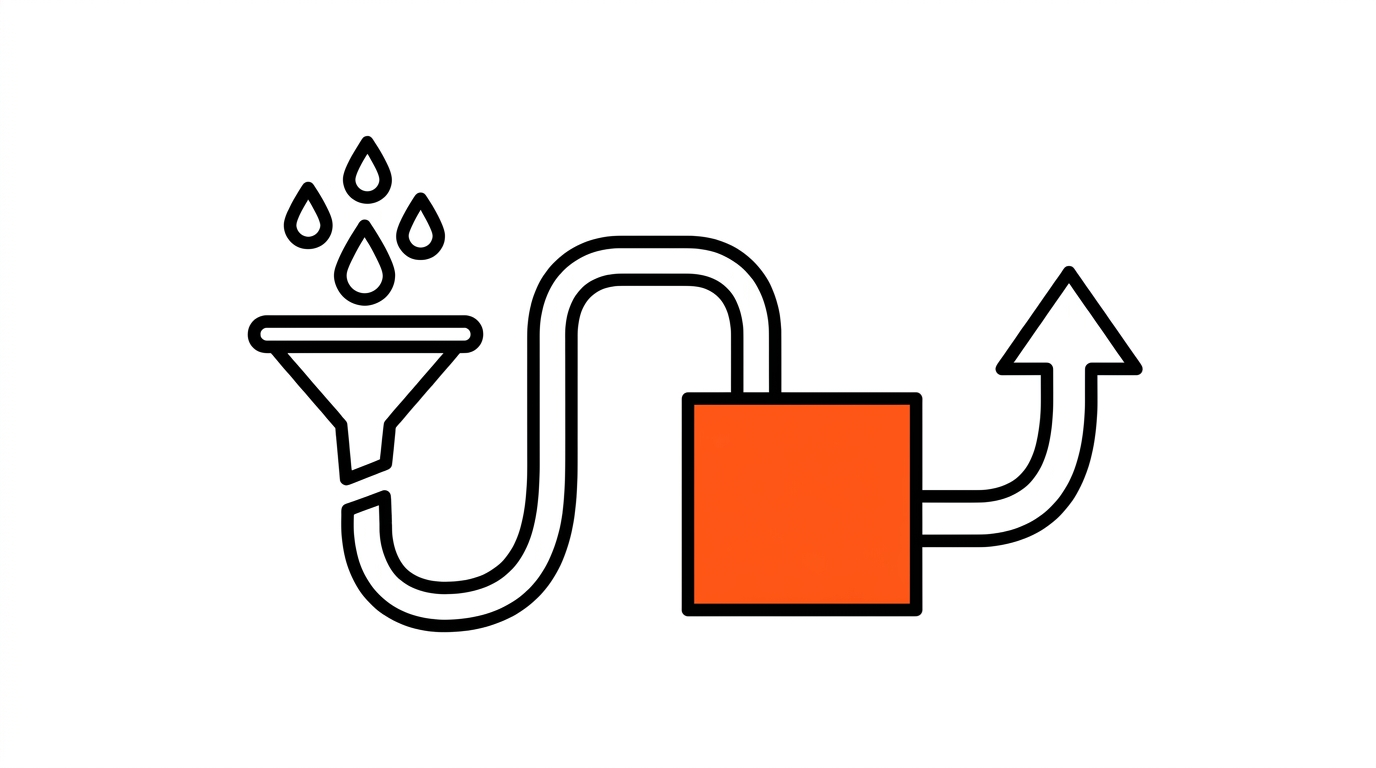
If you want more customers for your local service business, the answer is not another tactic. It is a diagnosis. Every growth problem lives at one of three stages: Capture demand (demand is reaching you but leaking before it converts into a lead), Convert demand (leads are coming in but not turning into booked work), or Generate demand (not enough people are finding you in the first place). Figure out which stage is your primary leak, then fix them in order. Ads are fuel, not a foundation. Running them before Stage 1 and Stage 2 are solid means you are paying to accelerate a leak you haven't patched yet.
Every page that currently ranks for "how to get more customers" gives you a list of tactics: optimize your Google Business Profile, get reviews, run a referral program, post on social media, try Google Ads. Good advice, every item. None of it tells you what order those things matter in, or how to figure out which one you actually need right now. This post is that diagnostic.
Stage 1: What is Capture Demand, and how do I know if it is leaking?
Capture demand is the stage where attention that has already found you converts into an inquiry. Someone searched for your service, clicked your listing or your site, and landed somewhere. Capture is everything that happens between that moment and the point where they actually contact you. When Capture leaks, you have traffic but no leads.
The signals are specific. A common one: a business has a decent map pack position and steady clicks, but the contact form gets almost nothing. Or a phone number is buried at the bottom of a page instead of visible in the header on mobile. Or the site loads in six seconds on a phone, and visitors bounce before the page renders. In every one of these cases the demand was there. The system just had no mechanism to catch it.
When we run our Demand Audit, Capture is one of the first things we check: does the site have a clear, frictionless path to contact from a mobile device? Is there a booking path or an easy-to-find phone number? Does the page load fast enough that a person on a slow connection will wait for it? These are not difficult to fix, but they are surprisingly easy to miss when you built the site yourself or it was built for you three years ago and nobody touched it since.
A useful self-test: pull up your own site on your phone with a fresh browser tab. Give it ten seconds. If you cannot find a phone number or a contact option without scrolling, your Capture stage has a problem. The person who found you through Google will not try harder than that.
Other Capture failures are harder to see. Forms that submit to an email address that nobody checks daily. Booking widgets that look broken on iOS. A "Contact Us" page that asks for seven fields when the person just wants to know if you serve their neighborhood. Each one is a place where earned attention walks out.
The good news is that fixing Capture pays off immediately and carries no recurring cost. A faster page, a prominent phone number, a simpler form: these are one-time repairs that hold. If you are going to spend anywhere first, spend here. The underlying framework is covered in more detail on how we build Capture systems for service businesses.
Stage 2: Why are leads not turning into booked jobs?
Convert demand is the stage between a lead arriving and a job being booked. The lead called, filled out the form, or sent a text. Now: how fast did someone respond? Was the follow-up personal or did it feel like an autoresponder from 2011? Did anyone follow up at all if the lead didn't book on the first contact?
The data on response speed is old but the behavior it describes has not changed. A 2007 MIT and InsideSales.com study of more than 15,000 leads across 100-plus companies found that calling a lead within 5 minutes made contact 100 times more likely than calling after 30 minutes (MIT Sloan / InsideSales.com, 2007). A Harvard Business Review audit of 2,241 U.S. companies in 2011 found the average first response to a web lead was 42 hours, and 23% of companies never responded at all (Harvard Business Review, 2011).
Local service businesses have an additional layer on top of that: missed calls. A 2024 study by 411 Locals monitored 85 businesses across 58 industries and found that small businesses answered only 37.8% of inbound calls. The rest went to voicemail or rang out with no answer (411 Locals, 2024). Combine the two: slow response plus a majority of calls going unanswered, and a business can have active demand, pay nothing for advertising, and still book almost none of it.
This is the most common Convert failure pattern we see when we wire up missed-call text-back for a business: the owner had no idea how many calls were going unanswered until the system started logging them. The incoming volume was real. The conversion rate was not a pricing problem or a competitive problem. It was a response problem, and no amount of leads was going to fix it while the response gap was open.
Trust signals matter here too, but at a different point than most owners think. Reviews are typically treated as a visibility tactic, something that helps you rank in the map pack. That's true, but the more direct impact is at the Convert stage: they are the thing a prospective customer checks after they find you, to decide whether to call at all. According to BrightLocal's Local Consumer Review Survey 2024 (n=1,141 U.S. consumers), 75% of consumers always or regularly read reviews before choosing a local business, and 71% will not consider a business rated below three stars.
The full Convert toolkit: a fast response to every lead (automated acknowledgment within minutes, human follow-up within the hour), a missed-call text-back so no unanswered call goes silent, a review engine that requests feedback after every completed job, and a simple follow-up sequence for leads that didn't book on first contact. Each of these is described in detail in the posts on how fast to respond to a new lead, missed-call text-back for local businesses, and how we build Convert systems.
Stage 3: What does it mean to generate demand, and when does it make sense?
Generate demand is the stage where people who have never heard of you become aware that you exist. This includes organic search (ranking on Google for your service plus city), the local map pack, word of mouth and referrals, AI answers (showing up when someone asks ChatGPT or Perplexity who offers your service in your area), and paid advertising. It is the most expensive stage to operate and the one that fails loudest when the earlier stages are broken.
A rough self-test for Stage 3: search for your main service in your city, on a phone, in a browser where you are not logged in. Do you appear in the map pack? Does your site appear organically? Ask a neighbor to do the same and see if they get the same results. If you cannot be found at all, that is a Generate problem. If you can be found but nobody contacts you, the problem is almost certainly at Stage 1 or Stage 2, not here.
The visibility infrastructure underneath Generate demand includes your Google Business Profile (claimed, complete, with current hours and photos), consistent name-address-phone information across directories, a site that Google and AI engines can read and index properly, and content built around the questions your customers actually ask. The technical side of that last piece is covered in the three layers of getting found: SEO, AEO, and GEO and in the broader piece on why visibility is an operations problem.
According to Google's own Google Business Profile documentation, businesses with a complete profile are 2.7 times more likely to be considered reputable and 70% more likely to attract location visits. That is not a claim about Google Ads. It is about the free infrastructure that most businesses have set up once and never touched again.
AI search adds a newer layer. When someone asks ChatGPT or Perplexity "who is the best HVAC company in Port St. Lucie," those engines are pulling from a combination of your review signals, your content, your schema markup, and your presence in sources they trust. How customers find businesses has changed substantially in the last two years, and the businesses that will be found in 2027 are the ones building that infrastructure now, as covered in how customers find local businesses now. Getting cited in AI answers is not a matter of luck. It is a matter of whether your digital infrastructure is built to the standard those engines require, as we cover in how we build Generate systems.
Paid advertising belongs here too, but as an accelerant. If your Generate baseline (organic search, map pack, AI citations) is solid and your Capture and Convert stages hold, ads produce a measurable return: you pour in volume, the system catches and converts it. If either earlier stage is broken, ads are an expensive way to find out. This is why Google Ads stop working for most local businesses: the ad works, the click happens, and then Stage 1 or Stage 2 drops the lead before it ever becomes a job.
Which stage is your problem? A plain diagnostic
Work through these in order. Stop at the first yes. That is your primary leak.
Do people find you in the first place? Search for your main service in your city from a fresh browser. Check Google search, the map pack, and Google Business Profile. If you are invisible or barely present, you have a Generate problem. Fix your profile, your site's technical foundation, and your content before anything else.
When people find you, do they contact you? Look at your analytics: how many sessions is your site getting each month, and how many of those result in a phone call, a form fill, or a booking? If sessions are reasonable but contacts are low, you have a Capture problem. The page is not converting the traffic it receives. Fix the speed, the mobile layout, and the path to contact.
When leads come in, do they become booked jobs? Count how many inquiries you received last month and how many became paid work. If that ratio is poor, you have a Convert problem. Check response time, missed call rate, and review count. The fixes are a missed-call text-back, a faster response workflow, and a review request system.
Most businesses have issues at more than one stage. But there is always a primary leak, and throwing money at the wrong one does not fix the right one. Running ads when Stage 1 is broken means paying for traffic your site cannot convert. Chasing reviews when Stage 3 is the actual gap means you are polishing trust signals for an audience that can't find you yet.
The Demand Audit we run at lyfework.io/audit checks all three stages: booking path, forms, missed-call setup, Google Business Profile accuracy, schema markup, AI-crawler access, page speed, and local search presence. It was built specifically around this diagnostic logic. The output tells you which stage is your primary constraint so you know what to work on first.
Why does the order of stages matter?
Because each stage multiplies the one before it, and fixing them out of order wastes money.
Consider a service business spending $1,500 per month on Google Ads. The ads drive 200 clicks. Of those 200, the site converts 5% into a contact: 10 leads. Of those 10, the business books 30%: 3 jobs. Cost per job acquired: $500.
Now fix Stage 1 first (Capture). Get the site converting at 10% instead of 5%: same ad spend, same 200 clicks, now 20 leads. Fix Stage 2 (Convert): get response time under 5 minutes and add a missed-call text-back, and booking rate goes from 30% to 50%. Now those 20 leads produce 10 jobs. Cost per job: $150. The ad spend is unchanged. The infrastructure under it did the work.
The reverse is also true. If a business has a 1% site conversion rate and answers 38% of calls (the 411 Locals baseline), doubling the ad budget produces twice as many leads at the same low conversion rate, and the cost per job goes up. You are paying more for the same result because the floor is still broken.
This is the argument against jumping to Stage 3 before the earlier stages are solid. Ads are not a solution to a Capture or Convert problem. They are a multiplier. And multipliers work in both directions.
The same sequencing applies to organic work. If you invest in content and local SEO to improve Generate, but the site you send that traffic to converts at 1%, you get more traffic to a leaky bucket. Fix the bucket first. The content compounds once the foundation underneath it holds. This is the core argument in visibility is an operations problem: more leads don't fix broken infrastructure, they just reveal it faster.
What should I actually fix first in my business?
Start with an honest look at your current numbers, not at what you wish they were.
If you genuinely have no idea how many leads came in last month, that is itself the problem. You cannot fix what you cannot see. The first repair is always to get visibility into the pipeline: set up call tracking or at least look at your call history, check your form submissions in email, count the inquiries that came through any channel. Businesses fly blind on this constantly, and it means every decision about where to spend is a guess.
Once you can see the numbers, the stage becomes obvious. No contacts despite some traffic: Capture. Contacts that don't convert to bookings: Convert. No traffic at all: Generate. Build in that order.
The one thing that is almost never true: that you need more ads right now. Ads belong at the end of this sequence, after the earlier stages hold. Most businesses that say "ads don't work" spent money on Generate before Capture or Convert were solid. The ads probably worked fine. The system underneath them didn't. See the full breakdown in why your Google Ads aren't working.