
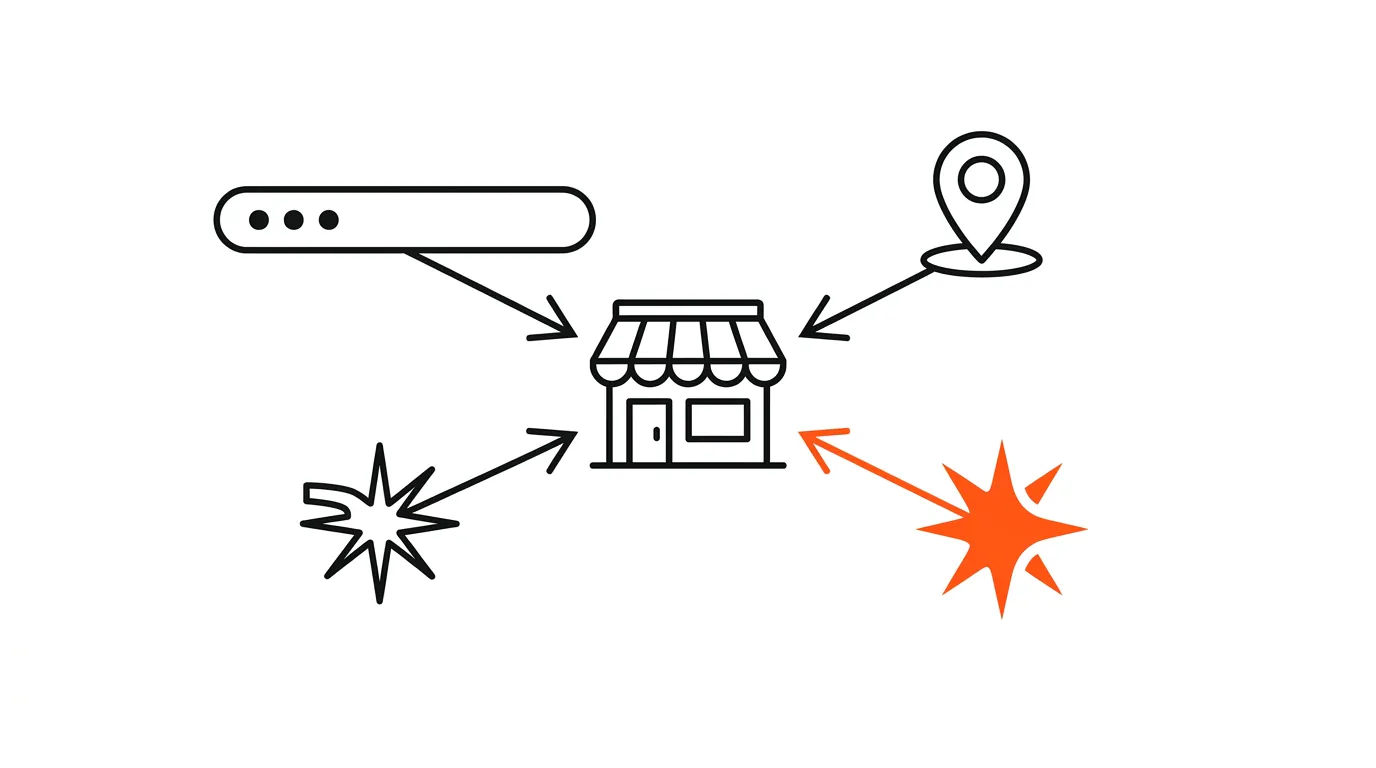
Customers find you in four places now: a Google search, an AI assistant's answer (ChatGPT, Perplexity, Google's AI Overviews), the map pack that pops up on a "near me" search, and word of mouth, which today shows up as online reviews. Ten years ago, getting found meant one job: rank on Google. Now it means showing up in all four, because the same person hops between them before they ever call you.
Think about how a customer actually shops. They ask Google on Monday, ask ChatGPT on Tuesday, then scan your reviews on the map before they pick up the phone. Each of those is a separate doorway, and each one decides who it shows by its own rules. Skip one and you go invisible to everyone who walks through it. Not ranked low, not on page two. Absent.
When we run an audit on a service business, the first thing the data shows is how scattered that demand really is. The "found you on Google" assumption almost never holds up. Across the audits we run, the discovery that now happens off classic search (in the map pack, in AI answers, in review-driven referrals) accounts for a large share of how customers first reach a local service business. That is the part most owners are flying blind on. This guide walks through how each of the four surfaces works in 2026, what decides who appears, and why building for all four together is cheaper than chasing them one at a time.
Where do customers find businesses now?
Customers find businesses across four surfaces today: classic search, AI answers, the map pack, and reviews. For years, online visibility was a single scoreboard, your position in Google's blue links. That scoreboard still matters. It just shares the screen, and the customer's attention, with three others now. Here are the four, roughly in the order a customer runs into them:
- Classic search. The organic Google (and Bing) results: the ten blue links and the features around them. Still the largest single source of intent-driven traffic for most local businesses.
- AI answers. The generated response from ChatGPT, Perplexity, Google's AI Overviews, Gemini, or Copilot. Increasingly the first answer a customer sees, often before they scroll to any link.
- The map pack. The block of three local businesses with a map, pulled from Google Business Profiles, that dominates "near me" and service-plus-city searches.
- Reviews and word of mouth. The star ratings, the review counts, and the reputation that decides whether anyone acts on the other three.
None of these is optional anymore. A business that ranks beautifully on Google but has no reviews still loses the click to the competitor with two hundred of them. A business with great reviews that no AI tool will mention quietly gets skipped by the growing share of customers who never leave the chat window. Winning one surface isn't the goal. Being present and consistent across all four is.
How does Google search decide who ranks?
Google ranks the sites it can read, that show real authority on the topic, and that people actually click when they appear. Everything else is detail on top of those three. Classic search is the most mature of the four surfaces, and the one owners most often misread. After Google's 2024 Content Warehouse documentation leak (thousands of internal ranking signals that briefly became public), we have firmer ground than ever on what moves rankings. The leak confirmed several things Google had downplayed for years: that a site-wide authority signal exists, that user click behavior is measured and fed back into ranking, and that brand-new sites sit in a kind of probation before they are trusted (reported by SparkToro and iPullRank, 2024).
The practical takeaway is a lot less dramatic than the headlines. Three things still decide whether you rank:
- Can Google find and read your pages? Crawlability and speed are table stakes. If a page is slow, broken, or buried, none of the rest matters.
- Do you have real authority on your topic? Google rewards sites that cover a subject thoroughly and consistently, and quietly discounts thin, scattered ones. Depth on a few things beats shallowness on many.
- Do real people choose you when they see you? Click and engagement signals mean the listing that earns the click (through a clear title, strong reviews, a fast page) tends to keep and improve its position.
The harder truth is that recovery is slow. When Google's Helpful Content system reshaped rankings, the recovery rate for sites it hit was roughly 22%, and even that was called modest (Glenn Gabe). The lesson is plain: building a healthy, trustworthy site costs far less than digging one out of a hole. If your business isn't showing up on Google at all, the cause is usually one of a handful of fixable problems, and we walk through each in why isn't my business showing up on Google?
How do AI assistants pick which businesses to name?
AI assistants name the businesses they can read clearly, that appear in sources the model already trusts, and that state answers in a format a machine can lift. When a customer asks ChatGPT "who's the best family lawyer in Tampa?" or watches Google answer a question above the blue links, a machine is doing the choosing, and it works from a different set of signals than a human scrolling results does. This is the surface that changed everything, and the one most businesses have done nothing about. It matters because the answer increasingly replaces the click. When Google shows an AI Overview, the click-through rate to the top organic result falls sharply.
Drop in click-through rate when an AI Overview is present on the results page. The answer is becoming the destination, not the doorway.
So how do AI engines decide whom to cite? Three patterns hold across the major tools:
- They favor sources that state the answer plainly and early. Content that front-loads a clear, quotable answer is far easier for a model to lift than content that buries the point under five paragraphs of warm-up.
- They lean heavily on established, corroborated entities. One analysis found Wikipedia accounted for roughly 47.9% of ChatGPT's top citations (5W Public Relations, 2024). That points to how strongly these systems prefer sources that are referenced elsewhere.
- They reward structure. A Princeton study on generative-engine optimization found that adding direct quotations lifted a source's visibility in AI answers by around 41%, and adding statistics by roughly 30-37% (arXiv 2311.09735). Format, it turns out, is leverage.
This is why brand presence (being mentioned, consistently, in places a model already trusts) now correlates more strongly with AI visibility than raw backlinks do. When we audit a business's AI footprint, the gap is usually stark. Plenty of companies rank fine on Google yet get named by zero of the AI tools we test, because nothing about their site is structured for a machine to quote. The work of closing that gap is concrete and learnable. We cover the practical version in how to get cited in ChatGPT and AI search, and the technical layer that makes a site machine-readable in llms.txt and schema, in plain English.
How does the map pack choose its three businesses?
Google picks the three businesses in the map pack on three factors: relevance (does your profile match the search), distance (how close you are to the searcher), and prominence (how well-known and well-reviewed you are). For any business with a service area, this is often the highest-intent surface of all. Someone searching "urgent care near me" isn't browsing. They are about to hire.
Relevance and distance you shape by filling out your Google Business Profile completely and accurately: right categories, services, service area, hours, photos. Prominence is where most businesses leave the map pack on the table, because it's built largely on reviews and on consistent business information across the web. A half-finished profile with eight reviews loses to a complete one with eighty, even when the half-finished business does better work.
The map pack is also the surface an owner can move fastest on without a developer. The practical, do-it-this-week version is in the Google Business Profile and map pack checklist.
Do reviews still matter for getting found?
Reviews matter more than ever, because they now feed the other three surfaces at once. Word of mouth never went away. It moved online and became measurable, and it turned into the connective tissue between every other surface: reviews feed the map pack's prominence score, they reassure the customer who found you on Google, and they are part of the reputation signal AI tools weigh when deciding whom to recommend.
of consumers read reviews when choosing a local business. Your rating is doing the selling, or the losing, before the first conversation.
The mechanics are simple, and most businesses still neglect them. Ask every satisfied customer. Make it effortless. Respond to every review, good and bad. Keep a steady drip instead of a one-time push. A fresh, growing stream of reviews tells Google and the customer that you're active and trusted; a wall of five-year-old reviews tells them the opposite.
Reviews are also the cheapest visibility you'll ever earn, because your existing customers generate them for free. The hard part was never the cost. It's having a system that asks, every single time, so it doesn't ride on someone remembering to. That same operational gap quietly bleeds leads elsewhere in a business, and we map the whole pattern in why service businesses lose leads.
Why these four surfaces compound
Here's the part that changes the math. These four surfaces aren't four separate projects fighting over your budget. They are one system, and each one makes the next easier.
A fast, well-structured website helps you rank in classic search. Ranking in search makes you more likely to be the source an AI tool cites. Being cited and mentioned consistently builds the brand presence AI engines reward, a signal that now correlates with AI visibility more strongly than backlinks do (Ahrefs, 2025). Strong reviews lift your map-pack prominence and reassure every customer who arrives from the other three. Each surface feeds the others.
This is also why one-off tactics disappoint. Buying a burst of ads or chasing a single keyword treats visibility as something you rent month to month, with nothing left the day you stop paying. The underlying system (a healthy site, structured content, a claimed and active profile, a steady review engine) is an asset that appreciates. It gets harder for competitors to displace precisely because it took time to earn.
Be honest about what that means. Getting found is no longer a marketing campaign you switch on. It's an operations question: whether the systems underneath your business are built and maintained, or improvised and neglected. We make that case in full in visibility is an operations problem, not a marketing one.
Start wherever you're weakest. Invisible on Google? Start there. No reviews? Start there. Just don't mistake the target. It was never about winning a single surface. It's building the system that wins all four and keeps compounding while you sleep, which is exactly where how SEO, AEO and GEO fit together picks up. If you want help identifying which surface has the biggest gap right now, the free visibility audit surfaces it in under two minutes. The full infrastructure we build, covering search, map pack, AI presence, and reviews, is what our local visibility service covers from the ground up.