
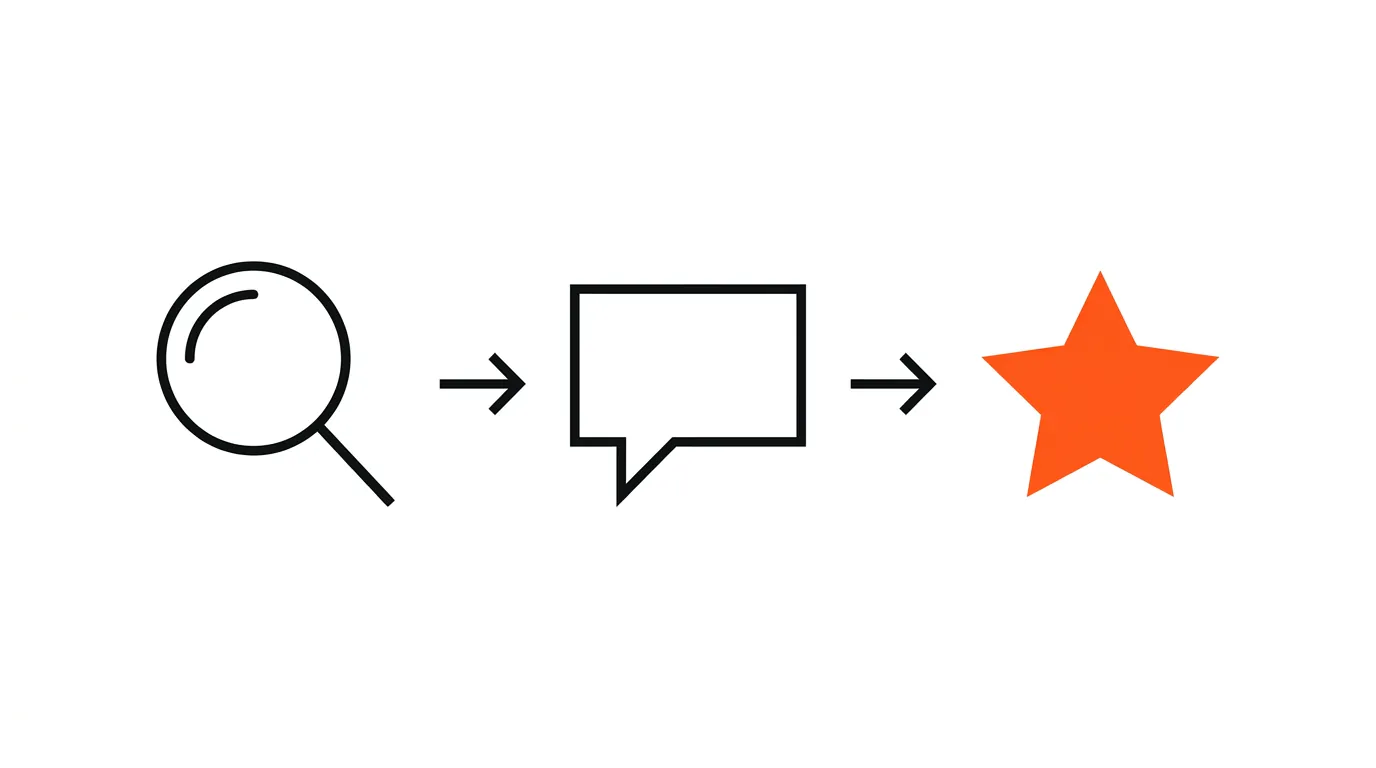
SEO gets you found, AEO makes you the answer, and GEO gets you recommended. They are not three competing buzzwords or three teams fighting over a budget. They are three layers of one visibility system, and the businesses that win at AI search build them in order: the foundation first, then the answer, then the recommendation. Skip a layer and the one above it has nothing to stand on.
That's the whole model in three sentences. The rest of this guide unpacks it: what each acronym actually means, why search split into three layers in the first place, why plain old SEO is still the floor everything else sits on, and the specific way to structure a site and write a page so Google and the AI assistants both quote you. No jargon for its own sake, just the system underneath getting found in 2026.
What do SEO, AEO, and GEO actually mean?
They are three jobs in one line: SEO gets you found, AEO makes you the answer, and GEO gets you recommended. Here is each one in plain terms.
- SEO (search engine optimization) is the work of getting found on a search engine at all, whether that's Google, YouTube, or even ChatGPT. It's the oldest of the three and the broadest.
- AEO (answer engine optimization) is earning the direct-answer slots: the featured snippet, the "people also ask" box, the little widget that answers a question without a click. It has been around far longer than ChatGPT.
- GEO (generative engine optimization) is getting seen, cited, and recommended inside the answers generative AI writes: ChatGPT, Perplexity, Google's AI Overviews, any model with access to the web.
If the acronyms ever start to blur, keep the one-line version: found, answer, recommended. The order matters more than the labels, because each layer leans on the one beneath it.
Why did search split into three layers?
Because search slowly stopped handing you the click. For years the deal was simple: rank a page, get the traffic, turn it into a customer. Then the answer started arriving before the click did, first as featured snippets, then as ChatGPT, then as the AI Overview sitting on top of Google's own results.
When an AI Overview appears, clicks on the top organic result fall by almost half. Ranking first is no longer the same as getting the visit.
That's the shift in one number. The page that "wins" the search increasingly loses the click, because the searcher already got their answer in the box above it. So getting found is no longer enough on its own. You now also have to be the answer in that box, and the name the AI gives when someone asks it who to call. Three layers, because search now resolves in three different places.
Why is SEO still the foundation?
Because the two AI layers are built directly on top of it. Generative engines don't invent their answers from nothing; they pull from pages that already rank and brands that are already mentioned across the web. If Google can't find and trust your page, neither can ChatGPT.
Anyone telling you SEO is dead has it backwards. The signals just feed more places now. The clearest proof is what actually lines up with showing up in AI answers:
Brand mentions across the web track AI visibility far more tightly than backlinks do, which sit at r = 0.218. Being talked about is the new being linked to.
SEO comes down to three fundamentals, and all three feed the AI layers too:
- On-site: content that genuinely answers the question, a structure that makes sense, and pages that convert once people land. Ranking a page that doesn't turn visitors into customers is a vanity exercise.
- Technical: schema markup, clean URLs, no broken pages. This is what lets an engine read and trust the page in the first place.
- Off-site: mentions, links, and complete profiles (your Google Business Profile, your LinkedIn, your YouTube). This is the reputation layer the AI engines lean on hardest.
If your business isn't showing up at all yet, the foundation is usually where the problem lives, not the AI layer on top. We walk through the usual culprits in why isn't my business showing up on Google, and map where customers actually find you in how customers find businesses now.
How do you win the featured snippet and answer box?
Answer one specific question cleanly, near the top of a page that's already relevant to it. The featured snippet, the "people also ask" box, and the little answer widgets all reward the same thing: a direct, self-contained answer to an exact question, with no preamble in front of it.
In practice that's three habits. Use the real question as a heading. Give the answer in a tight forty-to-fifty-word passage right underneath it. Lay out any steps or comparisons as a clean list the engine can lift whole. It's the same muscle as the capsule technique below, pointed at the precise phrase a searcher types. Win enough of these and you become the answer before anyone scrolls to the links.
How do you structure a site so AI will cite it?
Give every distinct service and every distinct place its own page, and make each page answer one clear question. The most common structural mistake is cramming every service onto a single page, which forces them to compete with each other and answers no one's search cleanly.
Picture a plumber. Instead of one "Services" page listing everything, you build a page each for emergency plumbing, pipe repair, water-heater installation, and bathroom remodels. Serve several areas, and you add a page for each one, then, to really own the local results, a page for the service in that place ("emergency plumbing in Westlake"). Done right that's a lot of pages, and that's the point: each one answers a specific, real search instead of blurring into a generic list.
The rule that keeps this from turning into spam is differentiation. Every page has to be genuinely distinct: its own title, its own first line, and above all its own schema describing that one service. For local businesses, that page structure is what wins the map pack, and we lay out the whole checklist in the Google Business Profile and map-pack checklist.
What is the capsule content technique?
Write so any single sentence still makes sense when you lift it out of the page. That's the whole technique, and it's the line between a post an AI can quote and one it scrolls past. The method is simple: make the heading the question your reader is actually asking, then answer it in the very next sentence, with no warm-up.
Here's the same point done badly and well. The bad version buries the answer: "In today's competitive market, businesses are increasingly realizing the importance of fast follow-up, and there are many factors to weigh." The good version leads with it: "Reply to a new lead within five minutes. After that, your odds of reaching them fall off a cliff." Only the second one can be lifted straight into an AI answer.
Pages that state the answer plainly and back it with specific statistics and quotes get pulled into AI answers far more often than ones that meander.
This post is written that way on purpose: every heading is a question, every section opens with its answer. It pairs with the machine-readable signals that help engines parse you, which we cover plainly in llms.txt and schema in plain English and in more depth in how to get cited in ChatGPT and AI search.
How do you get recommended, not just found?
Spread the same answer across the places the AI already trusts. Generative engines don't only cite your website; they pull from third-party mentions, reviews, and big reference platforms, which is why one topic should live in more than one place.
Nearly half of ChatGPT's top citations point to Wikipedia. AI answers lean on a handful of trusted, widely-referenced sources, not just whoever ranks first.
In practice that means taking one piece of work and giving it more than one surface: the blog post, a short video, a profile that stays current, a presence in the communities your buyers actually read. You're widening the number of places your name can be cited from, so that when someone asks an assistant who to hire, your business is the pattern it keeps seeing. That's GEO. Not a trick, but a wider footprint feeding the same answer.
SEO, AEO, GEO: where should you start?
Start with SEO, every time. Do solid, honest SEO and you've already done most of the work, because the foundation is shared, and the rest is structure and the capsule format on top. Chasing GEO tactics before the foundation exists is like decorating a house that has no frame.
The trap is treating visibility as a campaign you switch on, when it's really infrastructure you build once and maintain. That's the whole argument of why visibility is an operations problem: the businesses that get found, quoted, and recommended are the ones who built the system, not the ones who bought the most ads this month. Our Visibility services covers the SEO, AEO, and GEO groundwork for Treasure Coast service businesses in one integrated engagement.
Three layers, one system
SEO, AEO, and GEO aren't three strategies to pick between. They're one system in three layers: get found, become the answer, get recommended. Build them in that order and they compound, because every layer feeds the next.
The shift is already here. The answer box is the destination now, and it's going to recommend someone the moment your customer asks. Build the visibility system so that someone is you, or watch it quietly hand the job to whoever did. Once you're getting found, the next step is making sure your website converts those visitors into booked jobs. See how we approach that on the Booking Systems page.