
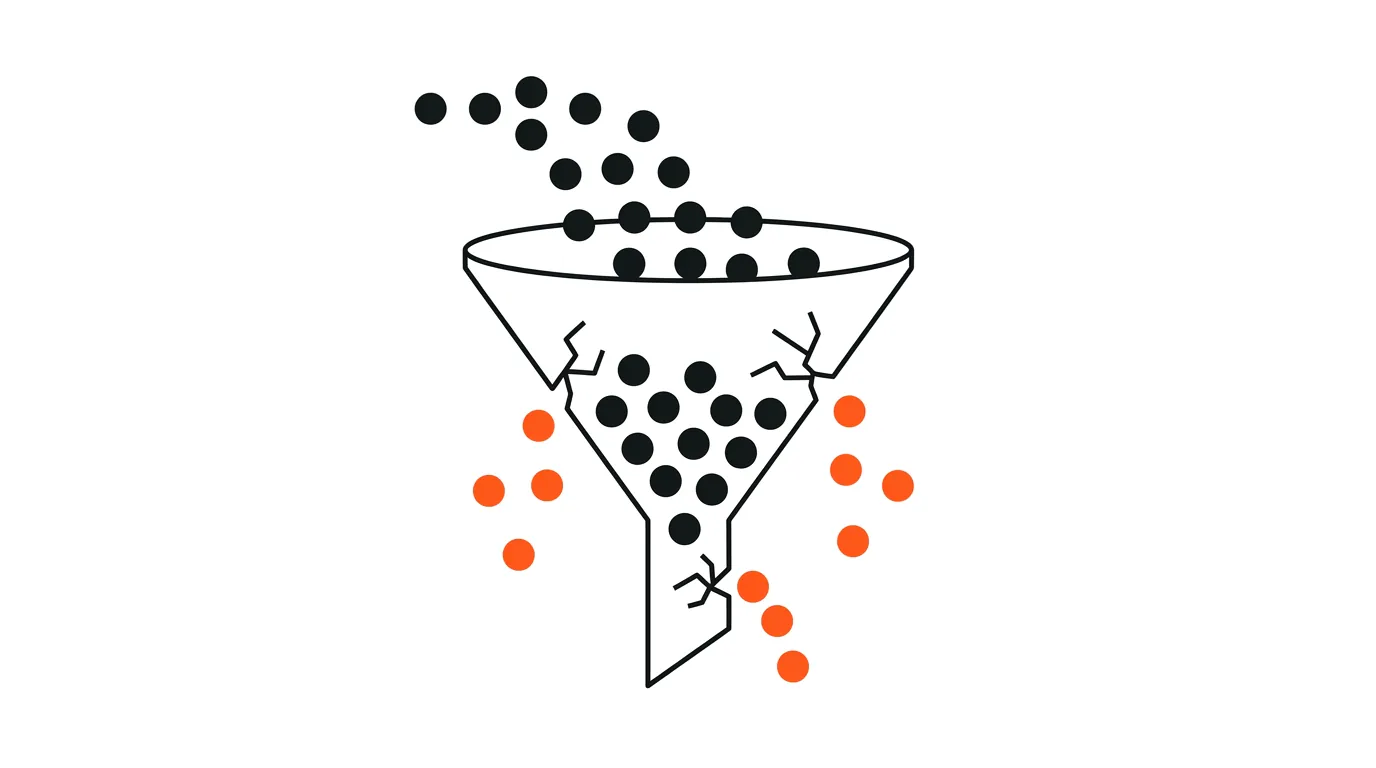
Most service businesses aren't short on leads. They're losing the ones they already get. Walk through the numbers and the calls and form fills are almost always coming in fine; they just slip away in the minutes and days after they land, before anyone gets back to them. What plugs that is a system: something that catches every lead, answers it on its own, and keeps following up until you book the job or hear a clear no. No bigger ad budget required, and nothing that depends on you remembering.
Here's the uncomfortable part. If your follow-up leaks, buying more leads just leaks more of them, faster, at a higher cost per job won. The businesses that pull away from the pack rarely found a better lead source. They stopped spilling the leads they were already paying for. The rest of this post walks the four places service businesses leak, what each hole quietly costs, and the one connected system that plugs all four.
Where do your leads actually disappear?
They disappear in the first few minutes after a lead lands, not in the lead source or the size of your list. When the phone goes quiet, the instinct is to go buy noise: call a marketing company, grab a lead list, push the ad spend up. A leaking bucket doesn't get fuller when you pour faster, though, and the leak is almost never where owners assume it is.
The average company takes 42 hours to respond to an inbound lead, and 23% never respond at all. Slow isn't the exception here. It's the field you're competing against.
Sit with that second number. Nearly a quarter of businesses never reply at all, so the bar to clear isn't "be exceptional," it's "answer quickly, every time," and most of your competition won't. That gap is the cheapest growth you'll ever find, and it's sitting in your own inbox.
The plain math is what makes it land. Buy ten leads, lose six to slow replies and dead-end voicemails, and the reflex is to go buy ten more, which leak the same way. Now you've paid for twenty to win eight, and your cost per customer has quietly doubled. Plug the leak first and those same ten might win you seven instead. Same spend, almost double the jobs. That's the whole case for fixing the floor before you turn up the volume.
What are the four places service businesses leak leads?
The four are speed, missed calls, follow-up, and after-hours inquiries. Across the systems we've built for service businesses, those same holes show up almost every time, and none of them are about lead quality. They're about what happens once a lead is already in your hands:
- Speed: you don't get back to them fast enough, and they've already called the next name.
- Missed calls: you're on a job, the phone rings out, and they don't leave a voicemail.
- Follow-up: you reach out once, hear nothing, and never circle back.
- After hours: the lead lands at 8pm or on a Sunday and there's no one there to catch it.
Plug one and you slow the bleed. Plug all four with a system and it stops. Take them in order.
Leak #1: you answer too slow
How fast you respond decides more deals than your price or your pitch does. A lead becomes a customer largely on the strength of who got back to them first, and most owners lose that race without ever knowing it ran.
Reply within 5 minutes instead of 30 and you're 100× more likely to reach the lead, and 21× more likely to qualify them. The odds of even making contact fall more than tenfold in the first hour.
Intent peaks the second someone hits send. They're sitting there with the phone in hand, and they almost certainly messaged two competitors at the same moment. Whoever answers first usually wins the conversation before price ever comes up. The trouble is that "reply in five minutes, every time, by hand" is impossible while you're running jobs, so the answer can't be willpower. It has to be a system that responds for you the instant a lead lands. (We break the timing down in how fast you should respond to a new lead.)
Leak #2: you miss the call
A missed call is usually a lost lead, not a delayed one. For most service businesses the phone is the lead, and you can't pick it up with your hands in someone's furnace, so calls ring out all day. The costly assumption is that the caller will try again. Most of the time they don't. They tap back to the search results and dial the next name on the list.
About a quarter of inbound calls to businesses go unanswered, and fewer than 3% of callers sent to voicemail bother to leave a message.
The fix runs without you. The moment a call goes unanswered, an automatic text goes out ("Sorry we missed you, what can we help with?") and the lead replies by text instead of vanishing. When we switch this on, calls that used to die in a voicemail box nobody checks start coming back as text conversations the owner can actually answer, and most of them are booked work. (More on whether it's worth it in missed-call text-back.)
Run the number for your own shop. Miss three callable jobs a week at a few hundred dollars each, and the missed-call leak alone costs more every month than the system that closes it. Most owners have never run that number, because a missed call leaves no trace: no complaint, no angry customer, just a month that came in softer than it should have.
Leak #3: you follow up once, then quit
One try is rarely enough, and quitting after it leaves most of your booked-job potential on the table. You called once, got no answer, figured they went with someone else, and moved on. Meanwhile the lead is still sitting there: busy, half-decided, waiting for a reason to pick you.
Most sales need five or more follow-ups to close, yet 44% of businesses give up after a single attempt.
"No reply" almost never means "not interested." It means they're on a job site, wrangling kids, or comparing three quotes and yours slipped down the pile. The businesses that win don't pester. They show up on a steady cadence: a text on day one, a check-in on day three, one more on day seven, each easy to answer. By hand, that falls apart the first busy week. As a system, it runs quietly in the background until the lead replies or books, then stops itself. (Here's the cadence that books jobs.)
Leak #4: the lead comes in after hours
A large share of inquiries land exactly when no one's at the desk: evenings, weekends, the middle of a job. By the time you see Saturday's form on Monday morning, they've already booked whoever answered Saturday night. You lost on availability there, not on anything a report would flag, and that invisibility is what makes the leak so easy to miss.
This is where a system quietly earns its keep. Instant auto-response and missed-call text-back don't keep office hours. They answer 9pm on a Sunday the same way they answer 11am on a Tuesday. The lead gets a real reply in seconds, the conversation starts, and you wake up to a booked job instead of a cold one. (More on channels and timing in text or call a new lead.)
Why can't you just fix this by trying harder?
Because it's a timing problem, not a discipline problem, and no amount of effort changes the timing. We hit the same pattern on almost every build: the owner is sure they'll stay on top of it themselves. They can't. The moment a lead comes in is almost always the moment you're least able to answer it, whether you're on a roof, under a sink, with a customer, or driving between jobs. The busier you get, the more leads you generate and the slower you answer them. You're the bottleneck, and you can't out-hustle being one person with two hands and a full day.
A system doesn't have that problem. It answers the five-minute lead while you're mid-install, texts back the missed call while you're driving, and sends follow-up number four while you're asleep. The point of building it isn't to make you faster. It's to take you out of the critical path entirely, so a lead getting answered no longer depends on you being free at the exact moment you never are.
What does the system that plugs every leak look like?
It's one connected setup, built once, that captures every lead, replies instantly, recovers missed calls, follows up on a cadence, and covers nights and weekends. None of the four leaks are marketing problems. They're operational, gaps in what happens after a lead arrives, so the fix runs every day without you touching it:
- Capture everything in one place. Website forms, calls, chat, and social DMs all land in a single inbox, so nothing lives only in a missed-call log or someone's text thread.
- Respond instantly. An automatic first touch in under a minute, so you beat the five-minute window on every lead, even elbow-deep in a job.
- Recover missed calls. Text-back fires the second a call rings out, turning the quarter you'd otherwise lose into live conversations.
- Follow up on a cadence. A multi-touch sequence that runs until the lead replies or books, then stops itself, so no one gets pestered and no one gets forgotten.
- Cover after hours. All of it runs nights and weekends, so the lead that comes in Sunday at 8pm is answered Sunday at 8pm.
No single tool is the point. What matters is that the whole thing runs without depending on you being at your desk, remembering to follow up, or getting to it later. You build it once, and it works every lead, every day, whether you're thinking about it or not.
Where should you start fixing the leaks?
Start with your single biggest leak, because most shops bleed worst from one or two holes, not all four evenly. You don't have to build all of this at once, and you shouldn't. Find yours with an honest gut-check:
- Speed. When a form comes in right now, how long until a real person replies: minutes, or hours?
- Missed calls. Pull last week's call log. How many rang out? Each was a lead deciding whether to call back, and most don't.
- Follow-up. Of the leads that didn't book, how many did you contact more than once? If the honest answer is "almost none," that's money on the table.
- After hours. How many inquiries land outside 9-to-5? If a real share shows up nights and weekends, you're handing them to whoever answers then.
Plug the biggest leak first, watch the same lead volume start converting better, then add the next piece. It compounds, and the first fix usually pays for the rest.
The bottom line: this is an operations problem, not a marketing one
Losing leads is an operations failure, and you fix it with systems, not campaigns. Marketing fills the top of the bucket. If the bucket leaks, better marketing only makes the leak more expensive, because you pay more per lead to lose them the same way. Speed-to-lead, missed-call recovery, a follow-up cadence that actually runs: none of these are campaigns. They're plumbing, the unglamorous operational layer that quietly decides who grows and who stays stuck buying leads to replace the ones they lost. It's the same pattern we keep coming back to: getting found is an operations problem too, not a marketing trick.
So before you go buy more leads this quarter, look hard at the ones you're already paying for. Plug the four leaks, build the system once, and every lead you earn from here gets a real shot at becoming a customer. That's a far cheaper way to grow than refilling a bucket that never stops draining.
The system that plugs all four leaks is what we build for service businesses through our AI receptionist and automation service: instant lead response, missed-call recovery, and a follow-up cadence that runs without you. If you also want more leads coming in to begin with, that is what our visibility service handles.