
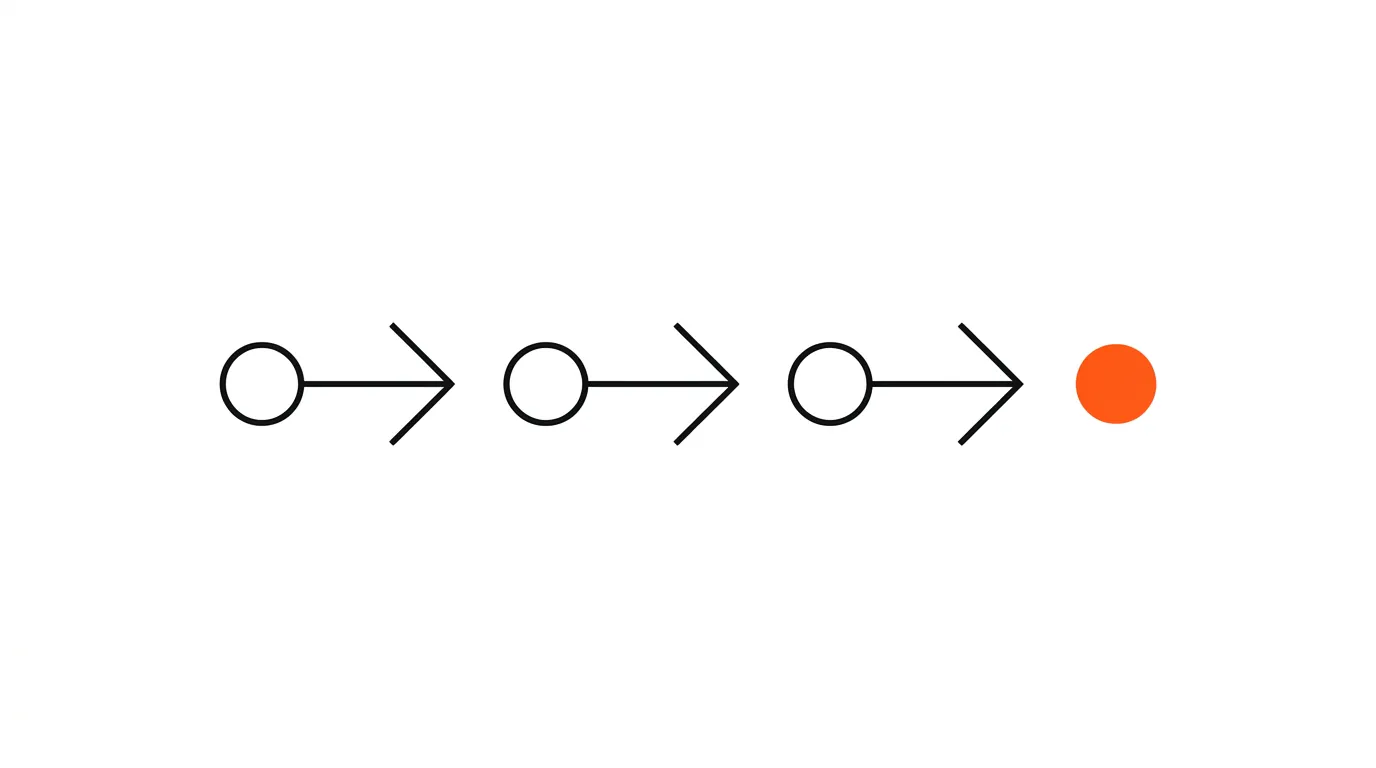
Plan on following up with a lead at least five times. Most sales close somewhere around the fifth touch, yet the majority of businesses stop after the first. A cadence that fits how people actually decide looks like this: reach out on day 1, again on day 3, again on day 7, then a lighter touch every week or two for about a month, and you stop the moment the lead replies or books. The one that "went cold" was usually waiting for touch number three or four, and most owners never get there.
This isn't about being clever or persistent for its own sake. The reason it works is that nearly everyone around you quits early, so the handful who keep going end up winning jobs no competitor even stuck around to compete for. Below: the persistence gap in plain numbers, a cadence you can copy starting today, how to make it run on its own so it doesn't depend on your memory, and how to keep it human instead of annoying.
Why does follow-up count matter so much?
Because there's a wide gap between the number of touches it takes to close a typical sale and the number a typical business actually makes. Most owners stop at one. Most sales don't come together until the fifth. That gap is the single most useful fact about follow-up, and almost nobody is acting on it.
About 80% of sales require at least five follow-ups to close, yet 44% of businesses give up after a single attempt. Most leads aren't lost to a better competitor. They're lost to silence.
Read those two numbers together. Almost half of businesses make one attempt and walk away, while most deals don't come together until the fifth. So the lead you wrote off as "not interested" after one unanswered text was, statistically, sitting right inside the window where the sale usually happens. The competitor who books that job simply kept showing up after you stopped, no sharper pitch or lower price required.
Strangely, that's encouraging news. You don't need a slicker pitch or a lower price to win more work. You need to do the dull, repetitive thing almost no one bothers to do, and come back a third, fourth, and fifth time. Persistence is one of the only edges in this business that costs nothing and sits there unused.
Why is a quiet lead almost never a dead lead?
No reply almost never means no. Owners hear silence and read rejection into it, but the far more common story is a lead who simply got pulled away. Picture their side of it. They fired off an inquiry between meetings, or while getting dinner on the table, or standing on a job site of their own. Your reply landed, they meant to circle back, and the day swallowed it. Nobody decided against you. They just got busy: kids, work, the other three quotes sitting in the same inbox.
A second touch reads as a small favor, not a nuisance. You're putting the decision back in front of someone who genuinely intended to make it and lost track. Most follow-up does the work of reminding, not convincing. The businesses that win understand that difference. Their job is to stay in view until the lead is finally ready to act, and then be the easy yes.
That's also why one touch and then nothing is the worst of both worlds. You spent the effort to make contact, then walked away right before the touches that actually land. You dug the well and stopped a foot above the water. It's the same leak we cover in why service businesses lose leads: the lead was never the problem. What happens after it arrives is.
What's a good follow-up cadence, and how far apart?
Front-load the touches while intent is high, then stretch the gaps so you stay on the radar without wearing out your welcome. In practice that's day 1, day 3, day 7, then a lighter touch every week or two for about a month. Here's a version you can lift as-is:
- Day 1, instant. The second the inquiry lands, a fast first touch. Speed is its own lever here, and that first reply wants to go out in minutes, not hours. (More on that in how fast you should respond to a new lead.)
- Day 1, later that day. If the first touch goes unanswered, a short nudge a few hours on: "Still want me to send that quote over?"
- Day 3. A fresh angle, not "just checking in" but something with substance: a quick question, a relevant example, a bit of proof.
- Day 7. One more, framed around their decision: "Happy to hold a spot this week if you're still weighing it."
- Then every week or two for a month. Lighter, low-pressure touches that keep you top of mind: a tip, an opening in the schedule, a simple "still here when you're ready."
Call it five to seven touches across four to six weeks. The early ones bunch together because intent runs hottest right after someone reaches out, and waiting three days to reply lets that heat drain away. The later ones spread out because by then you've stopped chasing a hot lead and started keeping a warm one in view. If they go fully silent after the month, don't delete them. Move them to a slower monthly check-in and get on with your day.
Don't agonize over the exact days. Day 1, day 3, day 7, then spaced is the shape, and the principle underneath it is front-loaded then tapering. What carries far more weight than the precise schedule is whether the cadence happens at all, every time, on every lead.
And the lift is real, not theoretical. Most clients come to us running what amounts to a one-touch cadence: they reach out once, hear nothing, and the lead quietly dies. When we replace that with a built-out sequence on this shape, the change is steep. More of those same leads start turning into booked work (same leads, same offer, just touches four and five that used to never get sent).
Should you follow up by text or email?
Mostly text. For a service business, text is the channel people actually open, and it isn't close. Where you follow up turns out to matter about as much as how often, so the time-sensitive touches belong on the channel that gets seen.
Texts get opened and answered far more than email: roughly 98% open and 45% reply, against about 20% and 6%. A follow-up nobody opens does nothing but reassure you that you sent it.
Those numbers are tough to argue with. Send your carefully timed cadence by email and four out of five touches never get opened, which means the schedule barely matters: most of them die in an inbox the lead stopped checking weeks ago. Put the time-sensitive touches on text and they get seen, which was the entire point. Email still earns its place for the heavier material (a detailed quote, a scope, photos of past work), but as the backup channel, behind text rather than in front of it. (We get deeper into the channel call in text or call a new lead.)
How do I follow up consistently when I'm slammed?
You don't do it by hand. You build the cadence once as a system and let it run on a schedule, because the part that fails is always the manual part. You read a piece like this, you resolve to follow up five times, and for a week you actually do. Then a hard stretch lands (three jobs back to back, a kid home sick, a truck in the shop) and the cadence is the first thing to slip. Not from not caring. From being one person, where the moment a lead needs touch number three is almost never the moment you're free to send it.
Doing this by hand doesn't scale, and the good news is it doesn't have to. A real follow-up system carries itself, and the four traits below are what make it work:
- It fires on a schedule. Day 1, day 3, day 7, and onward, the touches go out on their own, the same way each time, whether or not you remembered.
- It sends mostly over text, so the touches get opened instead of buried under unread email.
- It knows who's already in it. Every new lead drops into the sequence automatically, with nothing waiting on you adding them to a list.
- It stops the instant they reply or book. That's the part that makes the whole thing safe to automate (more below).
The aim was never to make you more disciplined about follow-up. It's to lift you out of the loop completely, so that whether you're on a roof, asleep, or out of town, every lead still works through the full five-to-seven touches it takes to book. People forget. A built system doesn't. It's the same pattern running across the whole lead-response stack, and missed-call text-back works for exactly the same reason, firing on its own the second a call rings out, with nothing held in your head.
Isn't following up that many times annoying?
Not if each touch is short, useful, and easy to ignore. Whether you come across as annoying has almost nothing to do with how many times you reach out and almost everything to do with how. Five thoughtful, useful touches spread over a month land like a business that's clearly on top of things. Five identical "just checking in!" pings in three days land like a stalker. Sameness and bad timing are what cross the line, not the count. The fear is fair (nobody wants to be the business that can't take a hint), but the count is rarely the thing that earns that reputation.
A handful of rules keep the cadence on the right side of it:
- Vary every touch. Each message should carry something new: a different angle, a question, a piece of proof, an opening in your schedule. Never paste the same line five times.
- Make each one easy to answer. A yes/no question or a clear next step beats a wall of text. Lower the cost of replying instead of raising it.
- Be genuinely useful. Lead with something that helps the lead decide rather than something that only helps you close: proof, clarity, a held spot.
- Always leave an easy out. A simple "tell me if now's not the time and I'll stop" makes you the opposite of pushy, and the people who don't take the out are quietly telling you they're still in.
Handled this way, persistence comes across as competence rather than desperation. You're the one business in the running that stayed organized enough to actually follow through.
The one rule that matters most: stop when they reply
If you carry one operational rule out of this whole piece, make it this one. The cadence must stop the instant the lead replies or books. Few things torch goodwill faster than an automated "still weighing it?" text the morning after someone already said yes. It signals to the lead, now your customer, that nobody was actually paying attention, and it makes the whole operation look careless at the precise moment you needed it to look sharp.
This is also the line between automation that helps you and automation that quietly embarrasses you. A sequence that blasts touch four at someone who answered touch two stopped being a system and became a liability. A real follow-up system watches for the reply, shuts itself off the moment it sees one, and hands the conversation to a person. Set up properly, the lead never senses the automation underneath. They just feel like they're dealing with a business that's genuinely on it.
That's the whole game: persistent enough to win the deals everyone else quits on, sharp enough to go quiet the second the lead is ready. Five-plus touches, mostly over text, front-loaded then tapering, running on their own, and ending the instant someone answers. Build that once, and you stop handing back the leads you already earned to the one thing that costs nothing to fix: silence. The follow-up sequence is one piece of the larger lead-response system we build under our automation service. It runs alongside the conversion-ready website that captures inquiries in the first place, so nothing falls through the gap between "visitor" and "booked job."