
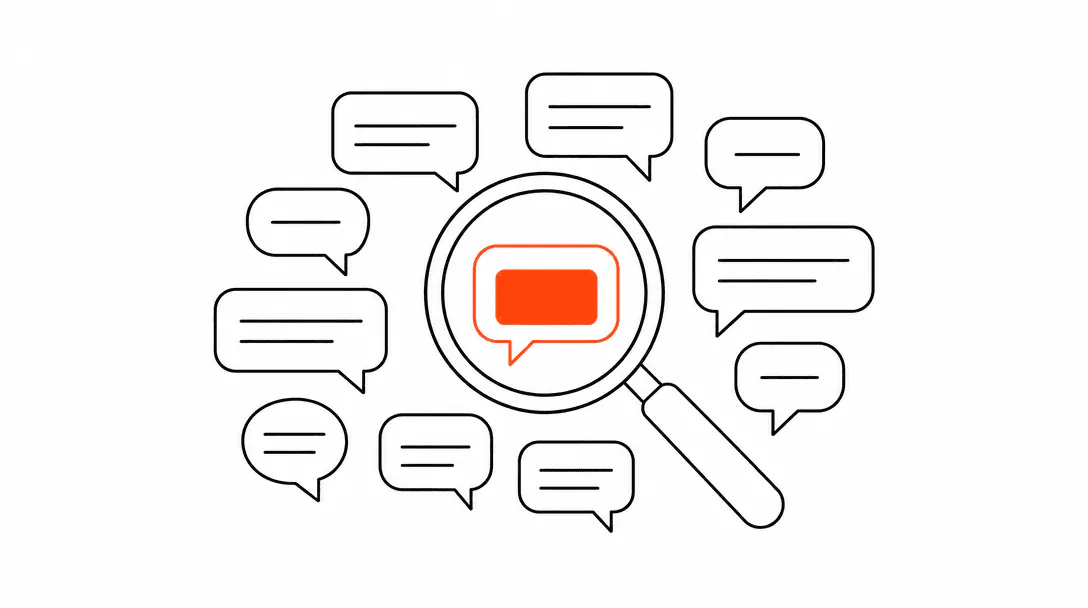
Your website copy is probably written in your language, not your customers' language. The gap between the two is where conversions go to die. Customer language research is the process of collecting the exact words, phrases, and descriptions your customers already use and building your site copy around those instead of the industry terms you reach for instinctively.
This post is part of the Turn Visitors Into Customers cluster. It covers angle research as a systems process: five mining sources, a vocabulary spreadsheet structure, and three copy tests that tell you whether your site is working with your customers or against them.
Why does using customer language improve conversions?
When a visitor reads words that match how they already describe their own problem, the page feels written for them rather than at them. That recognition reduces resistance in a way that polished prose cannot manufacture. You are not writing to impress anyone. You are writing to be understood instantly by a person who is comparing you to three other options they have open in other tabs.
The technical copy problem is actually a perspective problem. Business owners write from their vantage point: their credentials, their process, their terminology. Customers read from a different vantage point entirely: the problem they are trying to solve, the fear that the wrong hire will waste their money, and the very specific outcome they want.
Before writing a word of copy for a client, we pull every review they have received in the past two years and highlight the phrases that repeat. Whatever appears three or more times is the headline in disguise. It is what customers already say to their neighbors about the business. Those phrases belong on the homepage, not buried in a paragraph that the owner wrote from memory.
Where do you actually find the words your customers use?
Five sources give you a complete picture of how customers talk about your category, your business, and the problem you solve. You do not need all five every time. Your own reviews plus one other source will surface most of the vocabulary you need for a solid first pass.
1. Your own Google and Facebook reviews
This is the richest source by a wide margin. Read every review from the past two years. Copy every descriptive phrase into a spreadsheet. You are not looking for the five-star rating or the compliment. You are looking for the specific language people use to describe what they got: "they always show up when they say they will," "my yard never looked cleaner," "answered every question I had before I even thought to ask it." Those fragments are your copy.
Pay attention to what they mention first, because order signals importance. If the majority of reviewers mention reliability before quality, reliability belongs in your headline. Quality belongs further down the page.
2. Competitor reviews
Read the one-star and two-star reviews on your competitors. Those are your customers describing exactly what they do not want: "they didn't call before showing up," "the price changed from the estimate," "I had to follow up three times to get a straight answer." Every complaint is a promise you can make, provided you can actually keep it. Wire those promises into your copy as specific reassurances, not as vague claims like "great communication."
3. Inquiry and contact form messages
People write to you the same way they search for you. Pull your last 50 inquiry messages and look at how customers describe what they need. The vocabulary in a contact form message is almost never the vocabulary on the website they just came from. That gap tells you where your copy is speaking a different language than your customers.
4. Post-call and post-visit notes
If your team takes any notes after discovery calls or site visits, those notes are a transcript of customer language in real time. Look for the specific objection phrases ("we had a bad experience with the last company we used"), the outcome phrases ("we just want someone we can trust to handle it"), and the hesitation phrases ("I wasn't sure if this was even something you did"). All of those belong somewhere in your copy.
5. Reddit threads and forums
Search Reddit for your category plus the specific problem your customers have. A thread like "looking for a reliable HVAC company in [city], what should I ask before hiring?" is a gold mine. People are completely unguarded in forums because they are not talking to a business. The language they use there is the language they use when searching and when evaluating your site.
How do you organize what you find?
A vocabulary spreadsheet with three columns handles this cleanly. Column one: the raw phrase, exactly as the customer wrote or said it. Column two: the category (outcome, frustration, or objection). Column three: the source (which review platform, which inquiry thread, which call). That is the whole system. Do not overthink the structure.
Once you have 40 or 50 phrases across those three categories, patterns emerge fast. Outcomes cluster around two or three ideas. Frustrations tend to repeat almost verbatim across reviews. Objections are usually a short list of the same concerns stated different ways.
Each category maps to a section of your site:
- Outcomes belong in your headline, hero subheadline, and service descriptions. These are the results customers are buying, stated in their words.
- Frustrations belong in your problem section or the "why us" section. Name the frustrations you know your audience has before you propose the solution.
- Objections belong in your FAQ and in your trust section. Address the specific hesitations you collected, not the generic ones you guessed.
This is also where handling objections on your website gets real traction: when the objection language on your site matches the objection language in your customers' heads, the FAQ section stops feeling like a formality and starts doing actual conversion work.
What does the language gap look like in a real business?
Consider a pool service company whose homepage said "premium aquatic maintenance solutions." Their five-star reviews, across dozens of customers, all said some version of the same three things: "they show up every time," "don't leave a mess," and "my water is always clear." Two completely different languages for the same service.
The homepage was written from the owner's frame of reference: category signaling, professionalism, industry vocabulary. The reviews were written from the customer's frame of reference: reliability, cleanliness, and a result they could see with their eyes. The customer scanning that homepage was looking for proof of exactly what the reviews described. It was not there, so they kept looking.
Copy rewritten around that review vocabulary reads differently: "Clear water, every week. We show up on schedule, leave the yard clean, and handle anything we find." That sentence would not win a copywriting award. It would win customers, because it says out loud what they already hope is true.
of consumers regularly read reviews before choosing a local service business, making reviews the most accessible source of real customer language you have.
How do you know if your copy already uses the right language?
Three tests tell you quickly whether your existing copy is working with your customers or against them. Run these on your homepage and your main service pages before you do anything else.
Test 1: The headline test
Read your headline out loud and ask: would a customer say this to a friend? "Premium aquatic maintenance solutions" is not something a homeowner says. "My pool guy actually shows up" is. If your headline sounds like an industry brochure, it is written in your language. Rewrite it using one of the outcome phrases from your vocabulary spreadsheet.
Test 2: The objection test
Open your FAQ or trust section. Now open your vocabulary spreadsheet and look at the objection column. Do the concerns match? Most business websites have FAQ sections written around questions the owner wishes customers would ask, not questions customers actually ask. If "will you show up on time?" appears in eight reviews but nowhere on your site, that is a conversion gap you can close today.
Test 3: The CTA test
Look at your call-to-action buttons. Do they name the outcome the customer wants, or the action you want them to take? "Get a Free Estimate" names the action. "See If We're Available in Your Area" names a step in the process the customer actually cares about. "Find Out If This Is Right for Your Pool" names the decision the customer is trying to make. The language closest to the customer's actual thought is almost always the one that performs better.
This is the core of what makes website copy that converts: it closes the distance between what a visitor is thinking and what the page says. Customer language research is how you figure out exactly what they are thinking.
How do you actually wire the language into your site?
Start with the headline. Take the most frequently repeated outcome phrase from your reviews and put it verbatim (or nearly verbatim) in your homepage hero headline. Then move to the problem section: find the two most common frustrations and name them explicitly before you describe your solution. Last, rewrite your FAQ using the exact objection language from your spreadsheet.
The StoryBrand framework is useful here because it gives you a structure for placing customer language in the right sequence: their problem first, your solution second, their outcome third. The framework does not give you the words. That is what the research is for.
One practical note: do not clean up the grammar too much. "They always show up when they say they will" is slightly awkward. It is also more believable than "we are committed to punctual and reliable service delivery." The awkwardness is the authenticity. Polish it just enough that it reads naturally, then stop.
How often does the research need to be updated?
A full vocabulary audit every 12 months is usually enough for an established service business. The language your customers use does not change quickly. What does change: the specific objections that surface after you raise prices, after a new competitor enters your market, or after a service category gets a lot of attention in local news. Those are moments to run a fresh pass through your reviews and inquiry messages, because the concerns will have shifted.
Across the sites we build and maintain, the businesses that see consistent improvements over time are the ones that treat copy as a living document tied to customer feedback, not a one-time project. Reviews are a continuous data stream. The discipline is reading them as copy intelligence, not just as reputation management. Customer language research is part of every site we write through our web design and conversion service; we run the mining process before a word of copy is drafted so the homepage speaks the language your best customers already use. If you also want the site to rank for the searches those customers are running, that work lives in the visibility and SEO service that follows the build.