
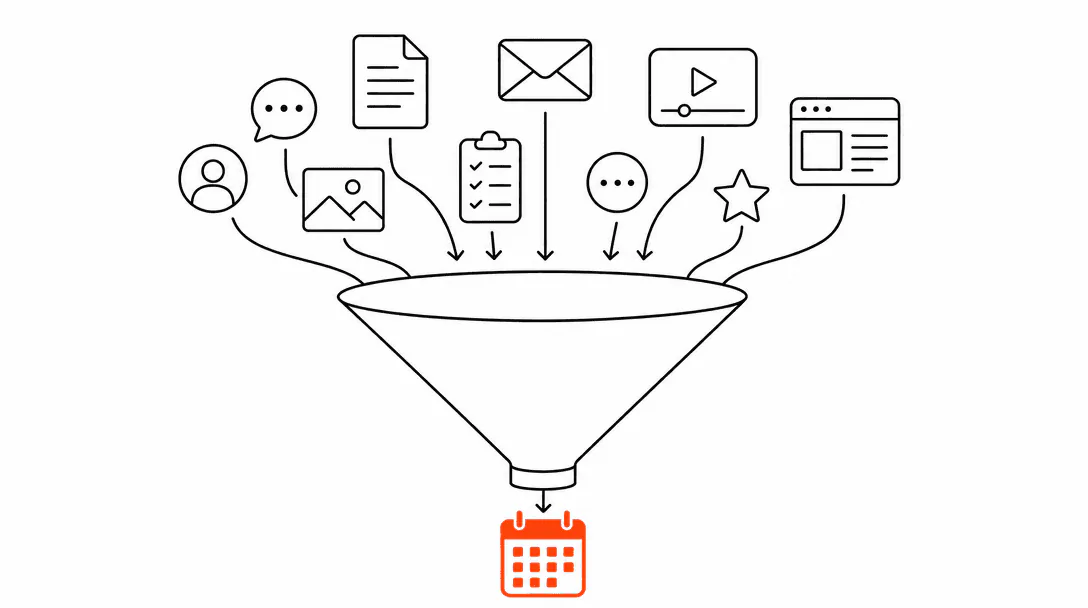
Most service business websites convert between half a percent and two percent of their visitors into actual customers. That means for every hundred people who find you online and click through, ninety-eight or more leave without booking anything. The traffic is there. The problem is everything that happens after the visit.
Turning visitors into customers is not a design problem or an advertising problem. It is an operations problem. Every page, every form, every follow-up message is a handoff point in a process that either holds the lead or drops it. This guide covers all of those handoffs: how to build the pages that earn the first click, the systems that capture the inquiry, and the follow-up that finishes the job.
Why does my website get traffic but no bookings?
Traffic without bookings almost always means the handoff is broken somewhere between the visitor landing and them taking action. When we audit a new client's site, we map every path from landing to booked and look for where the handoff breaks. Nine times out of ten the traffic is not the problem. The handoff is.
The most common break points look like this: a contact form that sends submissions to a shared Gmail nobody monitors before Tuesday morning, a phone number buried at the bottom of a page where visitors give up and leave, or a booking process that forces someone to call during business hours when they decided to reach out at 9 p.m. on a Sunday.
A roofing company we worked with was driving solid Google traffic to their site. The organic rankings were real, the pages looked clean, and the phone number was visible. Their conversion rate was under one percent. The reason: every contact form submission went to a group email that multiple people were watching but nobody owned. Leads would sit for a day or two before anyone replied, by which point the homeowner had already called two competitors. The fix was not more SEO. It was routing the form to a CRM with an immediate automated response, then building a follow-up sequence for anyone who did not reply within a few hours.
Read our deeper look at why service businesses lose leads if you want to understand the full pattern before diving into the fixes.
What do website pages actually need to do to convert visitors?
A page converts when it answers three questions immediately: what you do, who you do it for, and what the visitor should do next. Everything else on the page is secondary to those three things.
The homepage handles the first impression. It needs to communicate what you do and where you do it in the first few seconds, before anyone scrolls. "HVAC repair and installation for homeowners in Palm Beach County" is more effective than "Your trusted comfort partner" because it confirms to the visitor within two seconds that they have found the right place.
Service pages carry most of the conversion weight for organic traffic. Someone who searched for "roof inspection before hurricane season" and landed on your roof inspection service page is much closer to booking than someone who landed on your homepage. That page needs to describe the service in plain terms, show social proof from real clients, and make the next step visible without requiring any scrolling to find it.
For businesses running paid advertising or directing specific referral traffic, a purpose-built landing page with a single offer and a single call to action almost always outperforms sending that traffic to your general homepage. A landing page has no navigation links pulling people away, no links to other services, no distractions. It has one purpose and one next step. That focus alone tends to lift conversion rates significantly.
What should happen the moment someone fills out your form?
The moment a form is submitted is the most critical moment in your entire website. A visitor who filled out your contact form is warmer than any other visitor on your site. What happens in the next few minutes determines whether you book them or lose them.
Research from InsideSales and MIT found that reaching a lead within five minutes of their inquiry makes you roughly 100 times more likely to connect with them than reaching out after 30 minutes. The probability of making contact drops by factors after the first hour. Most service businesses do not respond that fast because they are relying on someone to manually check an email inbox, see the lead, and call them back. That process takes hours, if it happens at all.
Average time before a business responds to an inbound inquiry, and nearly a quarter never respond at all.
The fix is an automated text message that fires the moment a form is submitted. The visitor gets a reply within seconds, it confirms their inquiry was received, and it opens a conversation thread they can respond to from their phone. This alone holds the lead open until someone on your team can follow up personally. Paired with a notification to the right person on your team, this system means a new inquiry never sits in limbo.
For a closer look at response timing and what the research actually says, see our guide on how fast to respond to a lead.
What happens to visitors who call but do not reach anyone?
A missed call is a lead that almost walked out the door. About 26% of business calls go unanswered, and fewer than 3% of the callers who are routed to voicemail actually leave a message (Invoca, 2024). That means if you miss a call, the overwhelming majority of those callers just hang up and move on.
A missed-call text-back system sends an automatic text within seconds of a missed call. The text goes to the caller's number, it acknowledges the missed call, and it gives them a way to respond by text instead of waiting on hold or leaving a voicemail. Many callers prefer the text exchange to calling back anyway, especially if they are at work or in a public place. The system runs automatically without anyone on your team needing to do anything.
Across the systems we have built for service businesses, missed-call text-back is one of the fastest wins available. It requires almost no change to how your team operates, and it recovers a meaningful share of the calls that would otherwise be permanently lost.
How do I follow up with leads without it feeling like harassment?
The single most common mistake in lead follow-up is stopping too early. Research from Marketing Donut shows that most sales require five or more follow-up contacts, yet a large share of businesses send one message or make one call and then give up. From the business's perspective, one follow-up feels like enough. From the lead's perspective, they were busy when your first message came in and would have appreciated a reminder.
A follow-up sequence that runs automatically solves this. After a form submission and the immediate automated reply, a practical sequence might look like this: a personal follow-up text or call the morning after if there has been no response, a second text two days later, and one more touchpoint at the end of the week. That cadence is enough to convert a large share of the leads that did not respond immediately, and it does not feel aggressive when spread across several days.
The tone of the follow-up matters. A message that says "Just checking in to see if you are still looking for a roof inspection this season" is more useful than a generic "Did you see my last message?" The more specific and relevant the message is to what the person originally asked about, the more likely they are to respond.
Channel choice also matters. Text outperforms email on first contact for most service inquiries, because the open rate and response speed on a text is far higher than on an email. Email still earns its place later in the sequence, particularly for sending a proposal, an estimate, or a link to your booking calendar. The strongest systems use both: text for immediate touchpoints, email for documentation and the longer follow-through over the following days and weeks.
One pattern worth noting across the systems we have built: the leads that convert from the third or fourth follow-up are often the highest-quality clients. They were not avoiding you. They were genuinely busy, or they were comparing options, or they needed internal approval before committing. Persistence that is polite and spaced out is not harassment. It is just finishing what your marketing started.
Spacing, sequencing, and the content of each touchpoint in a follow-up sequence are covered in detail in our guide on why service businesses lose leads and how to stop the pattern.
Does online booking actually make a difference for service businesses?
For most service businesses, adding online booking is one of the highest-impact changes available. It removes the phone-tag step from the conversion process entirely. A visitor who is ready to hire you can lock in a time directly from your website, without waiting for a callback or sending an email that might take a day to get answered.
The difference in commitment level matters here. A visitor who fills out a "contact me" form has expressed interest. A visitor who books a specific appointment has made a decision. The second person is far more likely to show up and follow through than the first. Getting visitors to that second state, without requiring a phone call in between, shortens the sales cycle and reduces the number of leads that fall through during the back-and-forth.
Online booking also makes follow-up easier. When a booking is made digitally and flows into a CRM, automated appointment reminders can go out at set intervals before the scheduled time. This has a direct effect on no-show rates. A client who receives a text reminder the day before and an hour before their appointment is much more likely to show up, or to reschedule with enough notice for you to fill the slot, than a client who only got a confirmation email they never opened.
Why do online reviews affect whether visitors contact me?
Reviews are part of the conversion process, not just a marketing nicety. By the time someone is on your website, they are often already reading or about to read your reviews. Research from BrightLocal found that 71% of consumers regularly read reviews before choosing a local business. For service businesses where the stakes are high (someone coming into your home, a medical appointment, a legal matter), that number is likely higher.
Of consumers regularly read reviews before choosing a local business, making social proof a direct conversion factor.
The practical implication for conversion is that reviews should appear near your contact form or booking button, not only on a separate testimonials page. A visitor who has scrolled down to the bottom of a service page and is looking at your booking form is exactly the right person to show three specific, real reviews from clients who had the same service done. That proximity often provides the last bit of confidence they need to submit the form.
Getting reviews consistently requires a system, not a prayer. An automated follow-up message sent the day after a completed job, with a direct link to your Google review page, produces far more reviews than asking in person or hoping satisfied clients remember on their own. One tap, one click, review written. The friction has to be nearly zero or most people will skip it even when they had a genuinely good experience.
What connects my website to my sales pipeline?
The link between your website and your CRM (a CRM is the system where you track leads, clients, and their status) is where most service businesses lose the most money without realizing it. When a form on your website is not connected to your pipeline, every submission is just an email. Someone has to manually move that email into whatever system you use to track jobs, remember to follow up, and make sure nothing falls through. That process breaks constantly.
When your website form feeds directly into your CRM, a few things happen automatically. A contact record is created. A notification goes to the right person on your team. An automated response goes to the lead. And that lead shows up in a queue with every other active inquiry, where it can be tracked through to close. No lead survives by accident in this setup. Every lead has a next step assigned to it automatically, and the system surfaces anything that has not been touched.
The CRM also becomes the source of truth for where leads came from, which lets you see what is actually working. If a particular service page is producing twice as many qualified inquiries as another, you will know. If a paid campaign is sending clicks that never convert past the first reply, you will see that too. Without a connected pipeline, that data either does not exist or is buried in someone's email inbox where it can never inform a decision.
For service businesses that are early in building this infrastructure, the priority order matters. Fix where your form sends leads first, because every day you delay means more leads silently dropping. Then build the immediate automated response. Then layer in the follow-up sequence. Then look at the page quality and optimization work. That order reflects what produces the fastest return on the effort invested.
Why does the mobile experience matter so much for conversions?
Most people searching for local service businesses are on their phones. A page that takes four seconds to load on a cell connection, has form fields that require zooming in to tap, or buries the phone number below the fold is actively costing you bookings. Not theoretically. Right now, on every visit.
Testing your own site on a phone, as if you were visiting it for the first time and trying to contact yourself, is the fastest way to find what is costing you. Go through the process of filling out the form. Try tapping the phone number link. Try reading the page in a bright room where the contrast matters. The problems that show up in that exercise are the problems your visitors are experiencing.
Page load speed has a double effect: it affects whether visitors stay, and it affects whether Google sends organic traffic to you in the first place. Google uses page speed as part of how it ranks pages, through a set of measurements called Core Web Vitals. A fast page is not just more pleasant. It is a direct factor in how many people find you.
What should my website actually say?
Copy is the part of a website that most service businesses get wrong in a very specific way: they write about themselves instead of writing for the person who just landed on the page. A visitor who searches for "roof repair after storm damage" and lands on your page is not looking for your company history or a list of your values. They have a problem. The first thing your page should do is show them you understand that problem and can fix it.
Concretely, this means the first few lines of any service page should name the situation, name the outcome, and make it obvious the page is for them. "We repair storm-damaged roofs for homeowners in Martin County, usually within 48 hours of contact" tells a visitor everything they need to know to stay on the page. Compare that to "We are a family-owned roofing company serving the Treasure Coast with integrity and craftsmanship," which answers nothing the visitor was looking for.
Objections belong on the page too. If the most common reason someone does not call you is that they are worried about getting a vague estimate, address that. If they are worried about a crew showing up late, address that. The questions your past customers ask before hiring you are the exact questions your website visitors are sitting on right now, and answering them in copy does the same work a phone call with a salesperson used to do.
What does the full system look like when it is working?
A visitor lands on a service page that clearly answers what you do and who it is for. The page loads fast. Near the top and near the form, they see specific reviews from real clients. The booking form is short, three to five fields, and asks only for what is needed to start a conversation. When they submit, they receive an automated text within seconds confirming the inquiry. If they do not respond to that text within a few hours, a follow-up message goes out the next morning. If they called instead and you missed it, a text goes to their number within seconds of the missed call. Every booking flows into your CRM where reminders go out automatically before the appointment.
That is not an aspirational system. It is a description of the infrastructure that already exists for service businesses willing to build it properly. The pieces are available. The question is whether they are connected.
Most businesses that come to us have some of this in place. A website that exists. A phone number on the page. Maybe an email contact form. What is missing is the connective tissue: the form routing, the automated response, the follow-up sequence, the CRM integration that turns a website into a working pipeline instead of a digital brochure.
This pillar is the entry point to the full conversion cluster. The posts linked throughout go deeper on each piece: the landing page benchmarks, the exact timing of lead response, and the missed-call system that recovers what would otherwise be permanently lost. Build the foundation, then optimize each layer. That order works because each layer makes the next one more effective.
The full conversion system described here is what we deliver through our Booking Systems: web design, booking integration, and the follow-up infrastructure that keeps leads from going cold. Pair it with our AI Automation layer to handle every inquiry automatically, around the clock.