
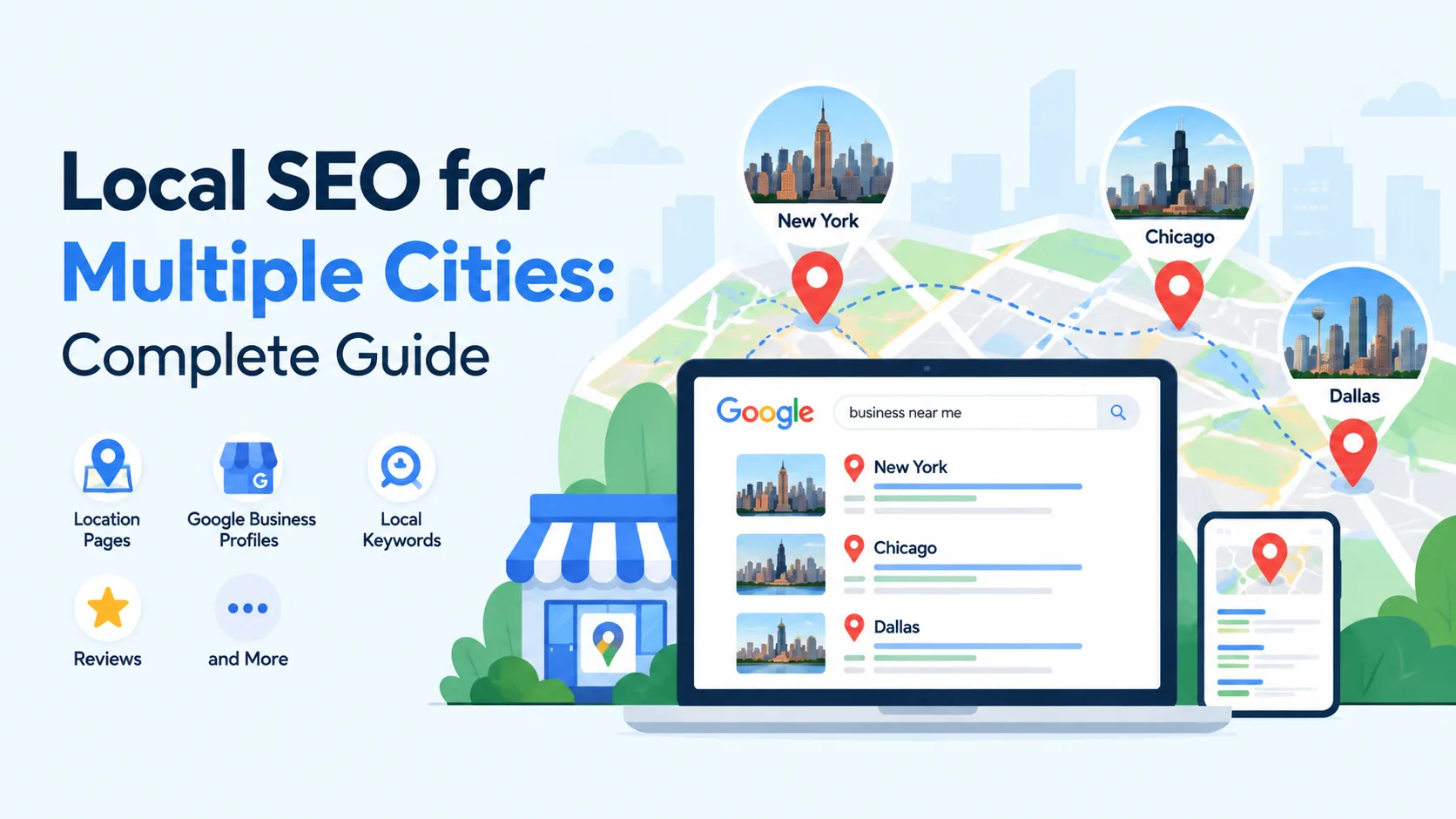
If your business serves customers in more than one city, ranking in local search can be more complicated than optimizing a single location.
A business may operate from one office while serving several nearby cities. Another business may have multiple physical locations across a region. In both situations, customers are searching for the same service with different geographic terms, such as "plumber in Stuart," "plumber in Jupiter," or "plumber near me."
This is where a well-planned local SEO strategy for multiple cities becomes important. Instead of trying to make one homepage rank for every location, businesses can build a structured local search strategy that combines location-specific website pages, Google Business Profile optimization, local content, reviews, citations, internal links, and other relevant signals.
In this guide, we'll explain how local SEO for multiple cities works, how to create location pages, what to do with Google Business Profile listings, common mistakes to avoid, and how to measure results.
What Is Local SEO for Multiple Cities?
Local SEO for multiple cities is the process of optimizing a business's website and online presence to improve visibility in local searches across multiple geographic areas.
The business does not necessarily need a separate physical office in every city to provide useful information about those service areas. Instead, its website can clearly explain where it operates and create helpful location-specific content where appropriate. A multi-city local SEO strategy may include:
- City and location pages
- Local keyword research
- Google Business Profile optimization
- Local citations and reviews
- Internal linking and local backlinks
- Service-area content and location-specific FAQs
- Technical SEO and conversion-focused landing pages
The objective is not to insert city names into a website as many times as possible. The objective is to make it clear to both search engines and potential customers what you offer, where you offer it, and how customers in each area can work with you.
Why Businesses Need a Multi-City Local SEO Strategy
Local search is strongly connected to geographic intent. Someone searching for "HVAC company" has a different intent from someone searching for "HVAC company in Stuart, FL." Likewise, "roof repair near me" communicates a strong local need even though the searcher does not specify a city.
A strong multi-city local SEO strategy can help businesses increase visibility in additional markets, reach customers searching for services in specific cities, strengthen geographic relevance, and support local customer acquisition.
For a service business, this matters because visibility is only the first step. The website also needs to make it easy for visitors to call, request a quote, schedule an appointment, or take another meaningful action. That is why local SEO should work together with the website, content, advertising, booking, CRM, and follow-up systems rather than operating as an isolated marketing activity.
Can a Business Rank in Multiple Cities?
Yes, a business can appear in search results for multiple cities. However, how you approach this depends on the business's actual operating model.
Businesses With Multiple Physical Locations
A company with legitimate offices, storefronts, or service locations in different cities can create location-specific information for each physical location. Each location should accurately represent the business operating there.
Service-Area Businesses
A service-area business may operate from one location while traveling to customers in surrounding cities. In this situation, the website can explain the areas served and create useful location content.
The important distinction is between serving an area and pretending to have a physical location there. Businesses should not create fake addresses or misleading local listings simply to try to rank in another city. A strong local SEO strategy should reflect the actual business.
How to Do Local SEO for Multiple Cities
1. Identify the Cities Your Business Actually Serves
Before creating pages or targeting keywords, build a list of your actual service areas. Look at where your customers live, where you currently provide services, areas your team can realistically reach, cities that generate revenue, and cities you want to expand into.
The important thing is to start with real markets, not an arbitrary list of cities.
2. Perform Local Keyword Research
Once you know which cities matter, research how customers search for your services — service + city ("plumber Stuart FL"), service + location ("plumbing services Martin County"), service + near me ("plumber near me"), and longer searches such as "emergency plumber in Stuart."
Do not create a separate page for every keyword. Instead, group related searches around a useful page that satisfies the searcher's intent.
3. Create Useful City and Location Pages
One of the most important elements of local SEO for multiple locations is creating useful location pages. But simply creating a URL for every city is not enough — each page should help a potential customer understand the business's services in that market. A strong location page might include:
- Services available in the city and nearby areas served
- Information about the service and the process
- Common customer questions
- Relevant testimonials
- Contact, quote, and appointment options
- Links to related services
The page should answer a basic customer question: "Can this business help me here?"
4. Avoid Duplicate City Pages
One of the biggest mistakes businesses make with multi-city SEO is creating dozens of pages that are almost identical, with the only meaningful difference being the city name. Instead, make each location page useful on its own by including local service availability, nearby communities, relevant customer questions, local testimonials, and unique FAQs.
The goal is not to make every page completely unrelated. The goal is to make every page meaningful to the people searching in that location.
5. Optimize Location Pages for Search Intent
Every location page should have a clear purpose and structure — an H1 naming the service and city, an H2 explaining what customers can expect, a section listing services provided, a section on nearby areas served, differentiators, an FAQ section, and a clear next step to request a quote or schedule service.
6. Optimize Your Google Business Profile
For businesses with eligible physical locations, the profile should accurately represent the business, including name, address, phone number, website, category, hours, services, photos, and reviews.
Businesses with multiple physical locations should manage each eligible location accurately. Service-area businesses should also represent their service areas according to Google's requirements. The key principle is accuracy: do not create fake locations simply because you want to rank for a particular city.
7. Build Consistent Local Citations
A local citation is a mention of your business information on another website or directory. For businesses with multiple locations, consistency becomes even more important — check that your business name, address, phone number, website, and location information are accurate across your profiles, and update listings rather than allowing conflicting details to remain online.
8. Build Relevant Local Backlinks
Local links can help establish geographic relevance and authority. Businesses can earn links through genuine relationships with local chambers of commerce, community organizations, industry associations, local publications, sponsorships, and business partnerships.
The objective should be relevance and credibility rather than collecting hundreds of low-quality links.
9. Create Helpful Local Content
Location pages are only one part of a strong local SEO strategy. Businesses can also create useful content around the questions their customers ask — local content should not exist simply to mention a city. It should answer a question, solve a problem, or help someone make a decision.
10. Optimize for "Near Me" Searches
Many local searches do not include a city at all. Instead of creating pages specifically designed around the phrase "near me," focus on the underlying local signals: accurate business information, Google Business Profile optimization, strong location pages, relevant local content, genuine customer reviews, local citations, and relevant local links.
Local SEO for Multiple Cities vs. Multiple Locations
These terms are often used interchangeably, but there is an important difference.
Multiple Cities
A business may have one physical location but serve customers across several cities. The website can explain the business's service area and create useful location pages.
Multiple Physical Locations
A company may have actual offices in several cities. Each legitimate location may require its own local optimization strategy, including location-specific website information and appropriate Business Profile management.
Understanding which model applies to your business is important before building your local SEO strategy.
How Many City Pages Should You Create?
There is no universal number. A business should create location pages based on its actual service areas and ability to provide useful information. Instead of asking, "How many city pages can we create?" ask, "How many locations can we create genuinely useful pages for?"
Before publishing a page, consider whether you actually serve the location, whether customers are searching for your services there, whether you can provide useful information specific to the market, and whether the page is meaningfully different from your other location pages.
Internal Linking for Multi-City SEO
Internal linking becomes particularly important as a website grows. A service page can link to relevant locations, and a location page can link back to the relevant service pages, creating a logical relationship between service and location. A well-organized structure separates Services (with individual service pages) from Locations (with individual city pages), which is much easier to manage than disconnected pages with no clear relationship.
Reviews and Multi-City Local SEO
Reviews can play an important role in local visibility and customer trust. Businesses should encourage genuine customers to leave reviews after completing a service, without telling customers what to write or requiring specific keywords.
For businesses serving several cities, genuine reviews from different service areas can also help prospective customers understand the company's geographic reach. Reviews serve two purposes: contributing to the broader local presence of the business, and giving potential customers additional information when deciding whether to contact the company.
Common Multi-City Local SEO Mistakes
Creating Hundreds of Nearly Identical Pages
More pages do not automatically mean more rankings. Prioritize useful pages over page volume.
Targeting Cities You Do Not Serve
Do not create location pages simply because a city has high search volume. Your website should accurately represent your service area.
Creating Fake Business Locations
Do not use fake addresses or create misleading Business Profiles to target additional cities.
Stuffing City Names Into Content
Repeating a city name over and over does not make a page more relevant. Write naturally for people first.
Ignoring Conversion Optimization
Ranking traffic does not automatically become customers. Your location pages should make it easy to call, request a quote, schedule an appointment, submit a form, or book a service.
Forgetting Existing Service Pages
Location pages should support your core services. Do not let your website become a collection of city pages without strong service pages explaining what the business actually does.
How to Measure Local SEO Performance Across Multiple Cities
A multi-city SEO strategy should be measured by location rather than looking only at overall website traffic. Track local keyword rankings for important service + city searches, organic traffic by location page, Google Business Profile activity for eligible profiles, and leads — phone calls, form submissions, quote requests, appointment requests, and bookings.
A city generating less traffic but more qualified leads may be more valuable to a business than a city generating large amounts of low-intent traffic. Review performance separately for each priority market to identify which locations need more content, stronger authority, better conversion paths, or additional optimization.
Local SEO Checklist for Multiple Cities
Use this checklist when developing your multi-city SEO strategy:
- Identify your actual service areas
- Research keywords for each priority city
- Group related keywords by search intent
- Create useful location pages with unique, location-specific content
- Optimize title tags, meta descriptions, and headings
- Add relevant internal links between services and locations
- Optimize eligible Google Business Profiles and keep information consistent
- Build relevant local citations and backlinks
- Collect genuine customer reviews
- Create useful local content beyond location pages
- Optimize pages for conversions
- Track rankings and leads by location
- Update important pages over time
Final Thoughts
Local SEO for multiple cities is not about creating the largest possible collection of city pages. It is about creating a clear, trustworthy online presence that tells potential customers where you operate, what services you provide, and how they can work with you.
Start with your most important markets. Research how customers search. Build useful location pages. Optimize your local business presence. Create helpful content. Earn relevant local authority. Then connect all of that visibility to a website that makes it easy for visitors to become leads and customers.
Not sure which cities to target, or where your current local visibility is leaking?
We build structured local SEO strategies that combine location pages, Google Business Profile management, citations, and reviews for service businesses across multiple markets. See how our local SEO service works or book a free strategy session.