
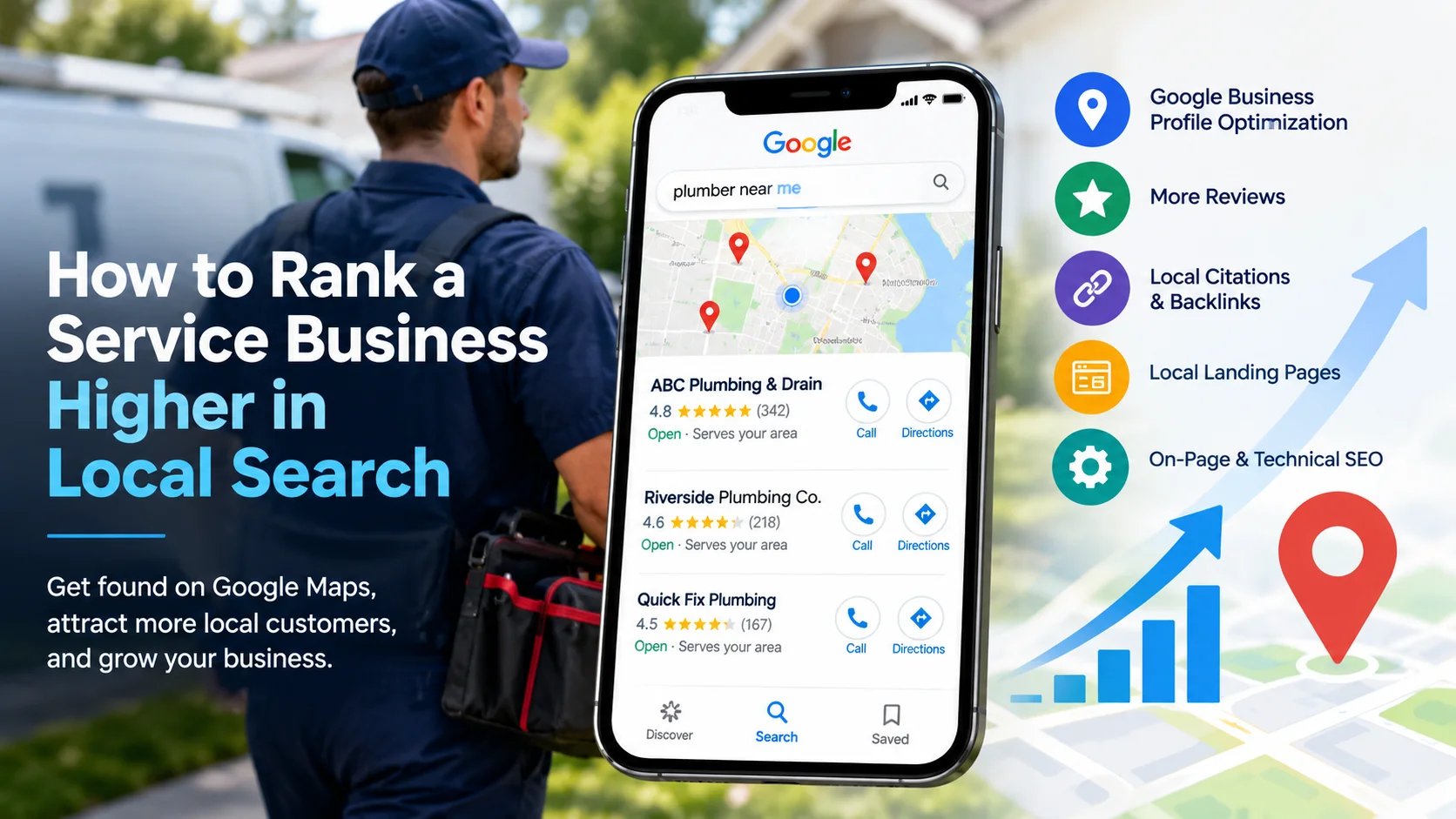
The good news is that local SEO for service businesses is not limited to businesses with storefronts. Service-area businesses can also improve their Google Maps visibility, organic rankings, and local 3-Pack presence by building a strong Google Business Profile, maintaining accurate business information, earning genuine reviews, creating useful local content, and establishing authority within the communities they serve.
So, how do you rank a service business higher in local search?
Start by improving the signals Google uses to understand your business, the services you provide, and the locations you serve. Then consistently build trust and authority across your website and other relevant online platforms.
Why Local Search Rankings Matter for Service Businesses
People searching for a local service often have immediate intent.
Someone searching for "emergency plumber near me" may need a plumber today. Someone searching for "best carpet cleaning company in Los Angeles" may already be comparing providers. A person searching for "HVAC repair near me" is likely looking for a company they can contact.
That makes local search particularly valuable for service businesses.
Google can display local businesses through Google Maps, the Local 3-Pack, localized organic results, and other search features. Appearing prominently in these results can increase:
- Phone calls
- Website visits
- Quote requests
- Appointment bookings
- Direction requests
- Local brand awareness
- Qualified leads
However, ranking locally is not about adding a city name to every page. Google considers multiple signals when determining which businesses are most relevant and trustworthy for a particular local search.
What Are Google's Local Ranking Factors?
Google states that local results are primarily influenced by relevance, distance, and prominence.
Relevance
Relevance refers to how well a business matches what someone is searching for. For example, if someone searches for "commercial carpet cleaning", a business that clearly provides commercial carpet cleaning services is more relevant than a business that only offers residential cleaning.
Your Google Business Profile, website content, services, categories, and other business information should clearly communicate what you actually offer.
Distance
Distance refers to how close the business is to the location associated with the search. The location may be based on the searcher's location, the location included in their search, or other signals Google uses to determine local intent.
You cannot simply optimize your way into ranking equally across an entire state or metropolitan area. Local search is inherently geographic.
Prominence
Prominence refers to how well-known and established a business appears to be. Google can use signals such as links, mentions, reviews, and other information across the web to understand a business's prominence.
This is why local SEO involves much more than optimizing your website.
1. Optimize Your Google Business Profile
Your Google Business Profile is one of the most important assets in a local SEO strategy.
A complete profile gives Google and potential customers more information about your business. Make sure your profile includes accurate and relevant information such as:
- Business name
- Primary category
- Relevant secondary categories
- Business hours
- Phone number
- Website
- Services
- Service areas
- Business description
- Photos
- Videos where appropriate
- Booking or appointment information when applicable
Choose categories that accurately represent your business rather than selecting categories simply because they contain valuable keywords.
Your profile should also remain accurate as your business changes.
If your hours change, update them. If you add a legitimate service, update your services. If your business information changes, make sure the change is reflected consistently across important platforms.
How Often Should You Update Your Google Business Profile?
There is no magic posting frequency that guarantees higher rankings.
Instead, focus on keeping your profile accurate and useful.
Add high-quality photos when you have something relevant to show, publish updates when you have genuinely useful information to share, and respond to customer reviews consistently.
The goal is not to make your profile look artificially active. The goal is to provide accurate information and demonstrate that your business is actively serving customers.
2. Make Your Business Information Consistent
NAP stands for Name, Address, and Phone number.
Consistent business information helps search engines and customers understand that different online listings refer to the same business.
Check important platforms and directories for:
- Business name
- Address
- Phone number
- Website URL
- Business category
- Hours
- Service information
Look for outdated phone numbers, old addresses, duplicate listings, incorrect business names, and other conflicting information.
However, NAP consistency should not be treated as a ranking trick where every punctuation mark must be identical across the internet.
The important goal is accurate, consistent business information across trusted and relevant sources.
3. Build a Website That Clearly Explains Your Services
Your website needs to make it immediately clear: what do you do, where do you provide the service, who do you serve, and why should customers choose you.
A strong service business website should have dedicated pages for important services rather than placing every service on one generic page.
For example, an HVAC company might create pages for:
- AC repair
- AC installation
- Furnace repair
- Heating installation
- Emergency HVAC service
- Commercial HVAC
Each page should explain the service thoroughly and naturally incorporate the locations the business genuinely serves.
Avoid creating dozens of pages that simply swap one city name for another while keeping the same content. Those pages provide little additional value and can create a poor user experience.
4. Create High-Quality Local Landing Pages
If your service business serves multiple cities, neighborhoods, or communities, local landing pages can help you target relevant geographic searches.
For example, a cleaning company serving Southern California might have legitimate location pages for the communities it actually serves.
A useful local landing page should include information such as:
- Services available in the area
- Types of customers served
- Common local service needs
- Relevant neighborhoods or communities
- Service availability
- Local project examples when available
- FAQs relevant to customers in that area
- Clear contact or quote options
The page should provide genuinely useful information about serving that location.
Avoid Doorway Pages
Creating hundreds of nearly identical pages solely to capture searches for different cities is not a strong local SEO strategy.
Instead, build fewer, better location pages. For example:
Weak approach: "Plumber in Miami," "Plumber in Fort Lauderdale," "Plumber in Hollywood," with almost identical copy.
Better approach: Create useful location pages that explain how your plumbing services specifically serve each market, with unique information and a clear reason for the page to exist.
5. Build a Review Strategy
Customer reviews are an important part of local search visibility and consumer trust.
The goal should not simply be to get as many reviews as possible.
Focus on obtaining genuine reviews from real customers. After completing a job, make it easy for satisfied customers to leave feedback.
A review strategy can include:
- Complete the customer's service.
- Follow up after the job.
- Provide a direct review request.
- Make the process simple.
- Respond professionally to reviews.
- Continue requesting feedback consistently.
Avoid purchasing reviews, creating fake reviews, or offering incentives in ways that violate platform policies.
Should You Respond to Google Reviews?
Yes. Responding to reviews gives your business an opportunity to demonstrate that you pay attention to customer feedback.
Keep responses professional and specific. For positive reviews, thank the customer. For negative reviews, acknowledge the concern and provide a professional path toward resolution without revealing private customer information.
6. Earn Relevant Local Backlinks
Backlinks remain an important part of SEO because they can help demonstrate authority and relevance.
For local businesses, relevant links can be particularly valuable. Potential opportunities include:
- Local news websites
- Chambers of commerce
- Community organizations
- Industry associations
- Local business organizations
- Sponsorships
- Community events
- Local partnerships
- Supplier or manufacturer websites
- Relevant local publications
The focus should be on quality and relevance, not collecting hundreds of low-quality links. A link from a respected local organization that genuinely relates to your business can be more useful than dozens of unrelated directory links.
7. Build Relevant Local Citations
A local citation is a mention of your business information on another website.
Common citation sources include business directories, industry directories, local organizations, and other relevant platforms.
Citations can help reinforce basic information about your business and make it easier for search engines and customers to understand your business across the web.
Prioritize:
- Accuracy
- Relevance
- Trusted platforms
- Consistent business information
Do not spend your entire SEO budget submitting your business to hundreds of low-quality directories.
8. Use Local Business Schema Markup
Structured data helps search engines understand information on your website.
For a local service business, relevant structured data can help communicate information about your organization, services, location, and other details where applicable. Depending on your business, your website may benefit from structured data such as:
- LocalBusiness
- Organization
- Service
- BreadcrumbList
- FAQPage where appropriate and eligible
Schema does not guarantee higher rankings or placement in rich results. Its primary purpose is to provide machine-readable context about your content.
9. Optimize for "Near Me" Searches
You do not need to repeatedly use the exact phrase "near me" throughout your website. Google can understand geographic intent without the words appearing on the page.
Instead, optimize for the underlying intent. For example, a local roofing company can create useful content around:
- Roofing contractor in [city]
- Roof repair in [city]
- Emergency roof repair in [city]
- Residential roofing services
- Commercial roofing services
- Roof replacement
- Roof inspection
Make your service areas clear on your website and Google Business Profile. The objective is to demonstrate that you genuinely serve the communities you are targeting.
10. Optimize for Google Maps
Google Maps visibility is closely connected to your local search presence. To strengthen your Google Maps SEO strategy:
- Optimize your Google Business Profile
- Choose accurate categories
- Keep business information current
- Maintain accurate service areas
- Collect genuine customer reviews
- Add relevant photos
- Build local authority
- Improve your website
- Create useful local content
- Maintain consistent business information
There is no single setting that guarantees a position in Google Maps. Local rankings depend on the searcher's location, query, competition, and multiple business signals.
How Do Service-Area Businesses Rank Without a Physical Address?
A service-area business, or SAB, travels to customers rather than receiving customers at a public storefront. Examples include:
- Plumbers
- Electricians
- Roofers
- Cleaning companies
- Landscapers
- Mobile mechanics
- Pest control companies
- HVAC contractors
These businesses can still appear in local search. If you operate as a service-area business, focus on accurately communicating where you provide services, the way our South Florida local SEO guide breaks down city by city. Your strategy should include:
Define Your Real Service Areas
Only list locations you genuinely serve. Do not claim an enormous service area simply to target more keywords.
Create Useful Location Pages
Build pages for important service areas when there is enough unique information and search demand to justify them.
Build Local Authority
Earn relevant links, mentions, reviews, and partnerships within the communities you serve.
Keep Your Google Business Profile Accurate
Your profile should accurately reflect how your business operates.
How Do I Get Into Google's Local 3-Pack?
The Local 3-Pack is the group of local business listings that can appear prominently in Google search results, often alongside a map.
There is no guaranteed formula for entering the 3-Pack. However, businesses can improve their competitiveness by strengthening the factors that influence local visibility.
Focus on relevance (make sure Google clearly understands your services and business category), distance (geographic proximity affects local results and cannot be completely overridden through SEO), prominence (build genuine authority through reviews, links, mentions, and an established online presence), website quality (create useful service and location content that satisfies local search intent), and business information (keep your business details accurate across important sources).
Local SEO Strategy for Service Businesses
A strong local SEO campaign should not depend on one tactic. Instead, think of local SEO as several connected systems.
| Local SEO Area | What to Focus On |
|---|---|
| Google Business Profile | Categories, services, hours, photos, accuracy |
| Website SEO | Service pages, location pages, technical SEO |
| Reviews | Genuine, recent customer feedback |
| Citations | Accurate business information |
| Backlinks | Relevant local and industry authority |
| Content | Helpful service and location-based content |
| Schema | Structured information about the business |
| Technical SEO | Speed, crawlability, indexing, mobile usability |
| Analytics | Organic traffic, leads, calls, conversions |
| Search Console | Queries, impressions, clicks, indexing |
The strongest results usually come from improving several areas together rather than relying on one tactic.
7 Steps to Improve Your Local Search Ranking
If you want a practical starting point, follow this process.
Step 1: Optimize Your Google Business Profile. Verify that your primary category, services, hours, phone number, website, photos, and other information are accurate.
Step 2: Audit Your Online Business Listings. Find outdated, duplicate, or incorrect listings and correct the information on important platforms.
Step 3: Improve Your Service Pages. Create detailed pages for your most important services and make sure each page satisfies the searcher's intent.
Step 4: Build Important Location Pages. Target the cities and communities you genuinely serve rather than creating hundreds of thin pages.
Step 5: Develop a Review Process. Ask genuine customers for feedback consistently after completing their service.
Step 6: Earn Local Authority. Build relationships with relevant local organizations, publications, businesses, and community groups that can naturally mention or link to your company.
Step 7: Measure Leads, Not Just Rankings. Track organic clicks, search impressions, local search queries, website leads, phone calls, quote requests, form submissions, bookings, and conversion rates.
Ranking is useful, but qualified leads and revenue are the real business outcomes.
What About Bing and AI Search?
Google remains a major source of local search traffic, but customers can discover businesses through other search engines, maps, directories, social platforms, and AI-powered search experiences.
The fundamentals still matter. AI systems need reliable information about your business. That means your business name, services, service areas, website, reviews, business information, local mentions, and structured data should be accurate and consistent.
Rather than creating content specifically to "game" AI search, focus on building a website and online presence that clearly establishes what your business does, where it operates, and why customers trust it.
Common Local SEO Mistakes Service Businesses Make
Even businesses that invest in SEO can make mistakes that limit their local visibility.
Using the Wrong Google Business Profile Category
Your primary category should accurately describe your main business. Do not choose a category simply because it contains a keyword you want to rank for.
Creating Duplicate Location Pages
Changing only the city name on dozens of pages does not create useful local content.
Buying Fake Reviews
Fake reviews can damage customer trust and may violate platform policies.
Building Low-Quality Backlinks
Hundreds of irrelevant links do not automatically create authority. Focus on relevant and legitimate opportunities.
Keyword Stuffing
Repeating phrases such as "best plumber in Miami" dozens of times makes content harder to read and does not create a better user experience. Use keywords naturally while focusing on search intent.
Ignoring Conversion Optimization
Getting more traffic does not help much if visitors cannot easily call, request a quote, schedule an appointment, or understand what to do next. Your local SEO strategy should connect visibility with conversion.
How Long Does Local SEO Take to Work?
There is no universal timeline for local SEO. A business in a low-competition market with an established website and strong reviews may see improvements sooner than a new business competing against established companies in a competitive market.
Results can depend on competition, location, website authority, existing reviews, Google Business Profile history, backlink profile, website quality, technical SEO, search demand, service area, and content quality.
Local SEO should therefore be treated as an ongoing process rather than a one-time optimization.
How to Measure Local SEO Success
Do not judge your local SEO campaign solely by whether one keyword moves from position 8 to position 4. Look at the bigger picture with dashboards that track:
Google Search Console: impressions, clicks, click-through rate, search queries, landing pages.
Google Analytics: organic users, engagement, landing pages, conversions, lead generation.
Google Business Profile Performance: calls, website visits, direction requests, search visibility.
Business Results: ultimately, ask whether more qualified local customers are contacting the business. That is the metric that matters most.
Final Thoughts
Ranking a service business higher in local search is not about finding one secret Google Maps trick.
It is about making your business relevant, trustworthy, geographically appropriate, and easy to understand.
Start with your Google Business Profile. Then improve your website, service pages, location pages, reviews, citations, backlinks, and technical SEO.
Most importantly, make sure every part of your online presence accurately represents the business you actually operate.
When these signals work together, you give Google stronger information about your business and give potential customers more reasons to choose you.
Need help improving your local search visibility?
If your service business is not appearing when customers search for your services in your target market, you may be missing valuable calls, quote requests, and bookings. Get local SEO help from Lyfework or book a free strategy session.