
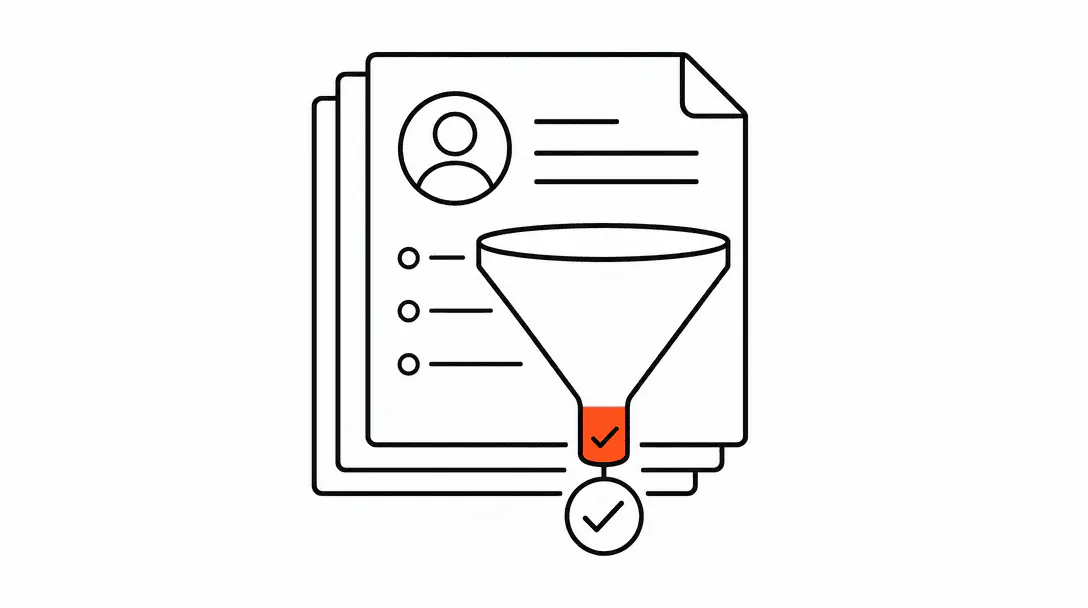
Yes, an AI agent can screen your job applicants by text before you ever pick up the phone. The agent fires a message within seconds of someone applying, asks the qualifying questions your team would normally handle in a phone screen, and flags only the candidates who clear every requirement. Everyone else gets a polite, automated response and never reaches your calendar.
For a service business owner who is personally doing the interviewing, this is not a small upgrade. It is the difference between spending three hours a week on phone screens with people who cannot pass a background check and spending thirty minutes talking to people who are actually qualified.
Why is hiring such a time drain for service business owners?
Hiring eats disproportionate time at service businesses because the owner is usually the only person doing it. There is no HR department, no recruiter on retainer, no coordinator scheduling the intake calls. Every application that comes in from Indeed or a posted flyer routes directly to the owner's phone.
The math gets painful fast. Post eight open positions, get forty applicants, and each phone screen takes fifteen to twenty minutes. That is ten to thirteen hours of calendar time before you have interviewed a single person who might actually get hired. Many of those calls will end in the first five minutes when you discover the candidate does not have the required license, cannot work the schedule you need, or lives too far away to make the commute practical.
A commercial cleaning company we worked with was in exactly this position. The owner was personally returning calls from Indeed applicants every morning before crew dispatch, trying to fill eight open positions across three shifts. Between the calls that went to voicemail and the ones where the applicant failed a basic requirement in the first two minutes, three to four hours per week were disappearing into a hiring funnel that had no filter. The work itself was not getting done faster. The owner was just spending more time on the phone.
This is a systems problem. The information needed to disqualify most candidates exists before the first call. A screening agent collects it automatically.
What does an AI applicant screening agent actually do?
An AI screening agent is a purpose-built automated conversation that runs by text or chat immediately after someone submits a job application. It is not a chatbot answering random questions. It is a structured intake: the agent asks a fixed set of qualifying questions, collects the answers, scores them against your criteria, and either advances the candidate or closes the conversation politely.
The sequence looks like this in practice. A candidate fills out a job application form on your website or on a job board. Within seconds, they receive a text: "Thanks for applying. We have a few quick questions to get started. What type of license or certification do you currently hold?" The candidate replies by text. The agent asks the next question. The whole exchange takes three to five minutes on the candidate's end, and zero minutes on yours.
When the candidate finishes, the agent evaluates the answers against your disqualifying criteria. Pass every threshold and the candidate lands in your qualified pipeline with a summary of their responses. Fail any hard requirement and they receive a pre-written message explaining the position is not a match at this time.
This connects directly to how agentic systems work at a broader level: the agent is not just firing a canned message. It is making conditional decisions based on structured inputs, the same pattern behind AI lead qualification and AI client onboarding flows. The difference here is that the domain is hiring rather than sales.
What questions should the screening agent ask?
The best screening questions come directly from your worst hires. When we set up a screening agent with a client, the discovery process starts with one question: "What have been your top five bad hires?" The owner lists them. Then we ask why each one did not work out. The answers are almost always in four or five categories: wrong license or certification, misrepresented experience, could not pass a background check, wrong availability, and too far away to make the schedule work.
Those failure categories become the agent's first five questions. Every question targets a genuine disqualifier from real experience, not a generic checklist pulled from a template. The commercial cleaning company's screening list ended up looking like this: current license status for the relevant equipment operation, availability for specific shift windows, distance from the service area, willingness to submit to a background check, and prior commercial cleaning experience (verified, not just claimed).
Beyond those custom criteria, most service businesses benefit from a few standard questions:
- Do you hold the required license or certification for this role?
- What days and hours are you available to work?
- How far are you willing to travel for work?
- Do you have reliable transportation?
- Have you passed a background check within the last two years?
The agent does not need to be clever. It needs to be thorough about the things that matter most to you. Five direct questions asked consistently to every applicant will give you more usable signal than twenty inconsistent phone conversations.
of small businesses using generative AI report efficiency gains in their operations.
What questions is the agent not allowed to ask?
Employment law applies to automated screening the same way it applies to a human interviewer. The agent cannot ask about age, national origin, religion, disability, pregnancy, marital status, family situation, or any other protected category under federal and state employment law. A question that would be illegal in a job interview is illegal in a text-based screening flow.
This is not as complicated as it sounds in practice. The questions that make a hire work out are almost always operational: can this person do the specific job, on the specific schedule, with the specific qualifications required? Those questions are legal and appropriate. The ones that get businesses in trouble are usually fishing for personal information that has nothing to do with the job.
We recommend having your employment attorney review the final question list before the agent goes live. That review typically takes less than an hour and gives you a document confirming the screening criteria are job-relevant. It is the same step you would take before printing a paper application form.
The agent should also include a clear disclosure at the start of the conversation: the candidate knows they are interacting with an automated system, not a person. Beyond being good practice, this aligns with disclosure standards that are increasingly expected in AI-driven interactions.
How does a qualified candidate get to a real interview?
When a candidate clears every threshold, the agent does two things. First, it sends the candidate a message confirming they have moved forward and either asks them to schedule a time or lets them know the hiring manager will be in touch. Second, it pushes a structured summary to wherever your team manages hiring: your CRM, a shared inbox, a Slack channel, or a simple email notification.
That summary includes the candidate's name and contact information, their answer to each screening question, a pass or flag note on each criterion, and any notes the agent collected (for example, if a candidate said they have a license but it is pending renewal, the agent flags that as a point to verify in the live interview). The hiring manager opens a tidy package of pre-qualified candidates rather than a pile of raw applications.
The unqualified candidates receive a polite, pre-written response. They are not ignored and they are not left waiting. The message thanks them for their interest and explains the position is not a match based on the current requirements. That close matters: a clean process protects your reputation as an employer, especially in local markets where word travels fast among job seekers in a trade.
This handoff pattern is similar to what we describe in the difference between AI agents and simple automations: the agent is making conditional decisions and routing outcomes, not just sending a fixed sequence of messages to everyone.
What happens when someone applies at 11 PM on a Sunday?
The agent responds in seconds, any time of day, any day of the week. An applicant who submits their form Sunday night gets the screening conversation Sunday night. By Monday morning, qualified candidates from the weekend are already sitting in your pipeline, screened and summarized, before you have had your first cup of coffee.
This matters more than it might seem. Job seekers, especially hourly and trade workers, apply when they have time: evenings, weekends, lunch breaks. A business that responds to applications within minutes gets more completed screening conversations than one that responds the next business day. The qualified pool is larger simply because fewer people drop off mid-process.
The same principle applies to internal knowledge agents built for team support: availability outside business hours is one of the clearest ROI signals for any AI agent, because the cost of a missed after-hours moment is real and measurable.
What does it take to set one of these up?
The setup process has four parts. First is the discovery conversation, the one where we ask about your worst hires, map your minimum requirements, and document the decision rules the agent needs to follow. This is the highest-value hour in the whole project because the quality of the screening logic determines everything downstream.
Second is the question sequence itself: drafting the text, sequencing it in a logical order, writing the branch logic for edge cases (what happens if a candidate says they have a license but it is in a different state, for example), and writing the close messages for both qualified and unqualified outcomes.
Third is the technical build: wiring the agent to your application form or job board, connecting it to your CRM or notification system, and testing the flow end-to-end with real test submissions before anything touches real applicants.
Fourth is the compliance review: having your attorney look at the question list and sign off, then adding the disclosure language to the opening message.
For a service business with clear minimum requirements, the whole setup typically lands in one to two weeks. There is no complicated software to install and no ongoing technical maintenance on your end. Once it is live, you set it and it runs.
Which service businesses get the most out of this?
The agent makes the biggest difference in two situations: businesses that are hiring regularly (multiple open positions at the same time, or recurring turnover in certain roles), and businesses where the owner or a senior manager is currently doing every intake call personally.
Trades businesses fit both. HVAC, cleaning, landscaping, electrical, plumbing: these businesses often have strict licensure requirements that eliminate a large portion of applicants immediately, and they frequently run lean enough that the owner is the one making those discovery calls. The agent handles the filter that should never have required a phone call in the first place.
Med spas, dental offices, and law firms also see strong results, particularly for high-volume support roles where certification verification and availability are the primary early gates. The agent does not replace the judgment call about whether someone is a culture fit or has the right experience depth for a senior role. It clears the administrative floor so those conversations are the only ones that happen.
How does hiring fit into a broader agentic operations setup?
Hiring is one of several recurring operational workflows that service businesses run on manual effort today and that benefit from the same agent architecture. Lead response, client onboarding, appointment reminders, review requests: each of these follows the same pattern as hiring screening. There is a trigger event, a set of qualifying or informational questions, a routing decision, and a handoff.
When we build these systems, we are usually building them as part of a connected operations layer, not as isolated tools. The hiring agent feeds into the same CRM that handles client onboarding and lead follow-up. The screening summary lands in the same place the owner already monitors the rest of the business. Nothing lives in a separate silo.
If you want to understand how this kind of multi-agent architecture fits together at the operational level, the overview of agentic systems covers the full picture, including when to use a single-purpose agent versus a connected system.
The short version: start with the workflow that is costing you the most time today. For many service business owners in a growth phase, that workflow is hiring. The agent does not change how you hire. It changes how much of your time hiring actually takes.
Hiring systems are one part of a connected operations layer. If you are also looking to automate how you handle leads, schedule appointments, and follow up with clients, our AI and automation services cover the full stack. And if you want more applicants finding your job listings in the first place, the same principles that drive local business visibility apply to your employer brand and job post rankings.