
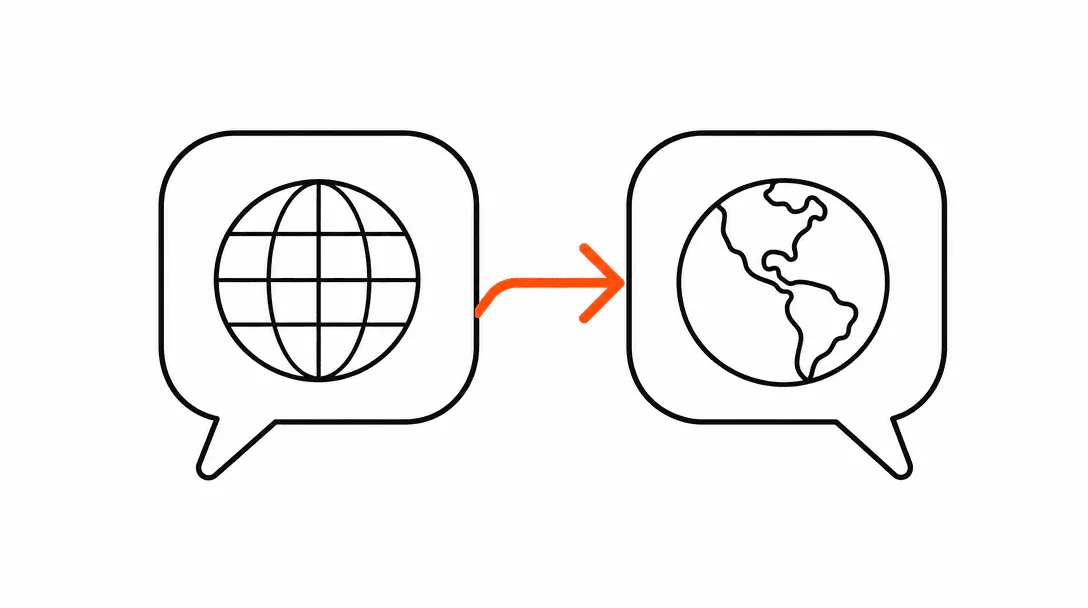
Yes: one AI agent can handle both English and Spanish customers, automatically, with no manual switching and no second person required. The agent reads the first message, identifies the language, and replies in kind. From that point forward, the entire conversation stays in that language until the customer changes it or the session ends.
For service businesses in South Florida and across the Treasure Coast, this is not a niche feature. It is table stakes. A meaningful share of inbound inquiries arrive in Spanish, and for most businesses, those inquiries either get a slow reply, a clumsy auto-translated response, or no reply at all. Any of those outcomes loses the customer. This post explains how a bilingual agent actually works, what you need to build one correctly, and where it hands off to a person.
How does language detection actually work inside the agent?
Language detection happens at the start of every conversation, before the agent generates any reply. The agent reads the incoming message, identifies the language, and sets the conversation context accordingly. Spanish stays Spanish. English stays English. If a customer sends a short opener like "Hola" followed by a mix of both languages, the agent defaults to Spanish and holds it there unless the customer shifts clearly to English.
This detection is not a separate translation step bolted onto an English-only agent. A properly built bilingual agent has its knowledge base written in both languages. That matters because service businesses use terms that translation engines consistently get wrong. "Estimate" becomes "presupuesto" or "cotización" depending on regional convention, and those two words carry different weight to a customer in Lake Worth versus a customer in Hialeah. "Maintenance contract" translates cleanly on paper but reads awkwardly in conversational Spanish. When we build the knowledge base for a bilingual deployment, we write the Spanish content ourselves rather than running the English through machine translation, because the goal is a conversation that feels native, not one that feels processed.
Why do Spanish-language inquiries bounce at the first response?
Spanish inquiries bounce because the first automated reply is almost always in English. That single mismatch signals to the customer that the business is not built for them, and they move on. The response delay compounds the problem: if the business relies on a bilingual staff member to handle those leads, and that person is in the field or off for the day, the inquiry sits unanswered for hours.
South Florida is one of the clearest test cases we have for this. We have deployed agents for clients where 30 to 40 percent of chat inquiries open in Spanish. Before the agent, those leads bounced at the first response because no one could reply quickly. Now the agent handles them without even flagging the team. The team only sees the lead when the agent has already qualified them, collected their details, and either booked an appointment or flagged for follow-up.
A landscaping company in Palm Beach County found itself in exactly this situation. Their Google Business Profile was generating Spanish inquiries from residential customers in communities like Royal Palm Beach and Greenacres, but their only Spanish-speaking crew member was in the field from 6 a.m. to 4 p.m. By the time anyone got back to an inquiry sent at 8 a.m., the customer had already called someone else. The gap was not in their work quality or pricing. It was a pure response infrastructure problem.
Average time it takes a business to respond to an inbound lead, across industries.
For a Spanish-speaking customer who contacted a business at 8 a.m. on a Tuesday, a 42-hour average response time means they hear back Thursday morning, if at all. An AI receptionist built for small businesses changes that math entirely: the response goes out in the customer's language within seconds, regardless of what time it is or who is available.
What does the knowledge base need to include for bilingual to work correctly?
The knowledge base needs complete, accurate content in both languages covering your services, pricing ranges, service area, booking process, and the most common questions customers ask before they decide to contact you. It also needs a clear escalation map: which questions the agent should answer directly, and which ones require a person.
The most common mistake we see is building a strong English knowledge base and then either translating it at the last minute or assuming the agent will figure out the Spanish side on its own. It will not, at least not reliably. A detail about your cancellation policy or deposit requirements needs to be stated in Spanish just as carefully as in English, because that is the version your Spanish-speaking customer will receive. Any ambiguity in the source content becomes an ambiguity in the customer-facing reply.
Escalation rules inside a bilingual agent also need to account for language at the handoff point. When the agent reaches a boundary and needs to pass the conversation to a person, the handoff note should include the language the customer was using. The staff member picking it up should not have to ask the customer to repeat everything or figure out from context that the conversation was in Spanish. That friction costs you the trust the agent spent the first several exchanges building.
This is the same principle behind how we think about AI customer support agents for service businesses more broadly: the agent is only as good as the information and rules you give it. Language is one layer of that. Accuracy of the underlying business content is the other.
What happens when a customer switches languages mid-conversation?
The agent follows the customer. If someone opens in Spanish and shifts to English three messages later, the agent matches the shift and continues in English. The conversation thread stays intact. There is no restart, no confusion, and no message asking the customer to select a language preference.
In practice, language switching mid-conversation happens more often than you might expect in South Florida communities like Boca Raton, West Palm Beach, and the Treasure Coast, where many customers are fully bilingual and may move between languages depending on the topic. Technical questions sometimes prompt a switch to English. Pricing conversations sometimes prompt a shift back to Spanish. A well-built agent handles both directions cleanly.
What the agent does not do is assume a switch based on a single borrowed word. If a customer writing in Spanish uses an English service term like "HVAC" or "landscaping," the agent does not flip to English. It recognizes the term in context and keeps the conversation in Spanish. That distinction matters because forcing an unnecessary language switch disrupts the flow and signals that the system is brittle.
To understand how this fits into a broader infrastructure picture, it helps to read about what an agentic system actually is and how language handling slots into the larger decision-making framework the agent runs on.
When does the bilingual agent hand off to a human, and how does that handoff work?
The agent hands off when it reaches the edge of what it can reliably answer: a question outside the knowledge base, a situation requiring judgment a script cannot provide, an explicit request to speak with someone, or a complaint that has escalated past a certain tone threshold. The trigger conditions are set during the build and can be adjusted as you learn where the edges are.
The handoff itself includes the full conversation transcript, the customer's name, contact information, the language they were using, and a brief summary of what the conversation covered. The person receiving the handoff should be able to open the notification and understand the situation in thirty seconds without asking the customer anything they have already said. That is the target, and it is achievable with the right routing setup.
For voice, the same principle applies. When a Spanish-speaking customer reaches a bilingual AI voice agent handling inbound calls, the handoff to a live person should preserve the language context just as clearly as a chat handoff. A customer who spent two minutes explaining their situation in Spanish should not have to explain it again in English because the handoff note missed the language flag.
The goal of the handoff is not just to pass a lead. It is to pass enough context that the human side of the interaction can start from where the agent left off, in the right language, with the right background, and without burning the customer's patience.
What does the CRM see when a bilingual agent handles a conversation?
Every conversation the agent handles creates a contact record or updates an existing one: name, phone or email, the channel they came through (chat, SMS, web form), the language they used, and a timestamped summary of what was discussed. If a booking was made, the appointment details attach to the record. If the agent flagged for follow-up, that tag appears in the pipeline.
From a reporting standpoint, the language data is valuable. It shows you what share of your inbound volume is coming in Spanish, which services are most commonly asked about in each language, and where the agent is escalating most often. Over time, that data points directly to where the knowledge base needs expansion or where a staff training gap exists.
None of that visibility existed for businesses relying on a single bilingual employee fielding messages manually. The agent creates a record for every conversation, including the ones that do not result in a booking. That is data you can actually use to understand your market, which in South Florida increasingly means understanding two languages equally well.
For businesses thinking about how their online presence fits into this, the visibility piece matters too. A business that shows up well in search across communities like Boynton Beach, Delray Beach, and the surrounding areas needs the infrastructure to actually handle the leads that visibility generates, across both languages. The guide to how South Florida businesses get found online covers the visibility side of that equation.
A bilingual agent is one of the fastest ways to close the response gap for Spanish-speaking leads without hiring additional staff. Our AI receptionist and automation service includes bilingual configuration as part of the build. If generating more of those leads is the priority, our local visibility service is designed specifically for Treasure Coast and South Florida service businesses that need to show up for the communities they serve.