
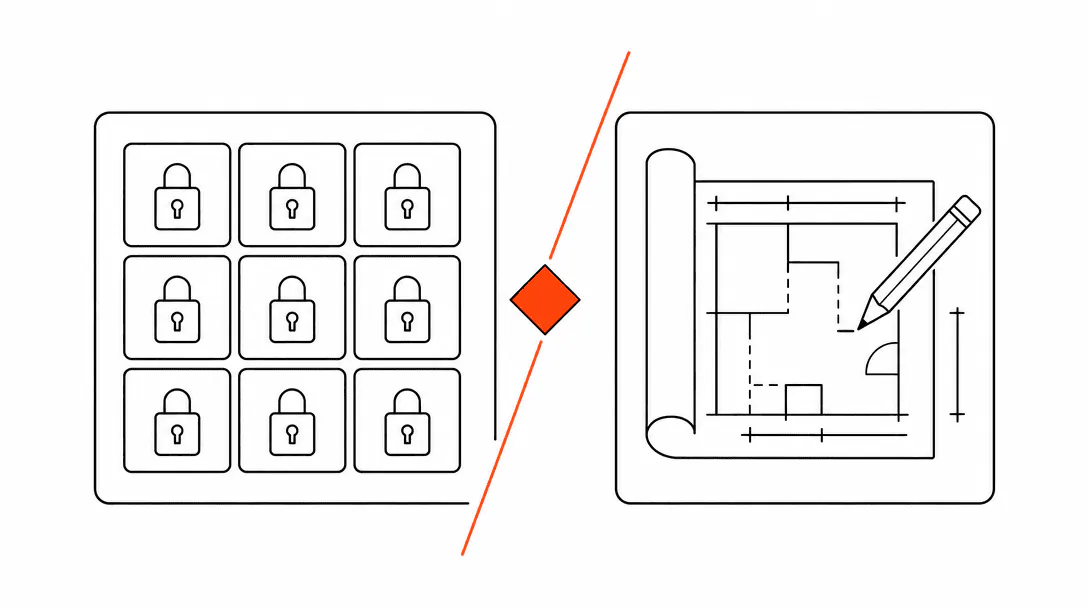
For most service businesses, a website builder is good enough right up until it isn't. The moment you try to wire in online booking, a CRM, or an intake form that actually syncs with something, you hit a wall the platform API cannot cross. That wall is the real decision point, not the monthly subscription price.
This post is part of the website foundation guide for service businesses. It covers one specific question: builder or custom, and how to know which one your business is actually ready for.
What is the real difference between a builder and a custom site?
A website builder gives you a pre-built system you rent and configure; a custom site is built to your exact specifications and hosted on infrastructure you own or control. The distinction sounds technical but the practical impact is operational. With a builder, you work inside the platform's rules. With a custom build, the rules are yours.
Builders like Wix, Squarespace, and GoDaddy Website Builder are genuinely good products for what they are designed to do: let a non-technical owner publish a professional-looking site quickly, without touching code. They handle hosting, security certificates, and basic SEO scaffolding. For a business whose site needs to show services, hours, and a phone number, a builder gets the job done at a fraction of the upfront cost of a custom build.
The ceiling appears at integration. Builders use proprietary app ecosystems. The booking tools, payment processors, and CRM connectors available to you are the ones the builder has chosen to support, through whatever API permissions they have negotiated. When the specific tool your business runs on is not in that ecosystem, you're either stuck or you're building workarounds that break over time.
When does a builder work fine?
A builder is the right call when your website's primary job is credibility and contact, and that job is not likely to change in the next two years. A builder works when all of the following are true:
- Your main goal is a professional web presence with your services, photos, and contact information.
- You do not need booking, intake forms, or any integration with your operational tools.
- You are in the early stage of business and cash is more constrained than time.
- You or someone on your team is comfortable maintaining it without developer help.
A lot of solo service providers fit this profile. A house cleaner who books by phone, a personal trainer taking clients through DMs, a handyman who gets all his work through word of mouth. For them, a Squarespace site with good photos and a clear phone number is genuinely sufficient. The investment makes sense.
Where business owners get into trouble is staying on a builder past the point where it still fits. The platform is often not the problem. The mismatch between what the platform can do and what the business now needs is the problem.
When does a builder end up costing you more than a custom build?
The hidden cost of a builder is the workaround tax. Each time the platform cannot do something natively, you add a paid add-on, a manual process, or a third-party connection that is fragile. Those costs stack, and none of them go away when you finally outgrow the platform.
We have migrated three service businesses off Wix and Squarespace in the past year. In every case the trigger was the same: they tried to add a booking widget or connect a CRM and hit a wall the builder platform API simply could not cross. They had been paying for add-ons and patching workarounds for months before deciding a rebuild made more sense. By the time we audited their stacks, the monthly cost of bolt-ons was often higher than what a properly maintained custom site would run.
A salon owner we worked with had built her own Squarespace site and it looked great. The problem surfaced when she wanted to add online booking with text confirmations and a client intake form that synced with her calendar. Each piece was technically possible through Squarespace's app market, but the combination required three separate paid tools that did not talk to each other cleanly. The intake form worked on desktop but broke on mobile. The booking tool sent confirmation emails but not texts without a fourth add-on. She was spending more time managing the stack than using it. When we rebuilt the site with proper integrations, all of that collapsed into one connected system.
of small businesses using AI-assisted tools and software report efficiency gains from those systems, according to the OECD Digital for SME Survey, 2025.
The efficiency gains that survey captures depend on systems that actually connect. A website that cannot talk to your booking tool, your CRM, or your follow-up sequences is not part of that efficiency stack. It is an island.
What does cost actually look like across both options?
Builder subscriptions run anywhere from free (with platform branding and limitations) to $40+ per month for a business-tier plan. Add the cost of a custom domain, an email add-on, a booking tool, a review widget, and any CRM connectors, and you can easily land at $150 to $250 per month before a developer has touched a single line of code.
A custom build for a service business typically requires a meaningful upfront investment, often starting in the low thousands. That covers design, development, testing, and launching a site built around your specific operational needs. Monthly costs after launch are primarily hosting and maintenance, and those are often lower than a fully-loaded builder subscription.
The financial case for going custom is strongest when: you know you need booking or CRM integration now, you are actively generating leads, and you expect the site to be a real growth channel. If you are pre-launch or still figuring out your services, a builder gives you a place to start without locking capital into infrastructure you have not yet validated.
Who owns the site, and why does that matter?
On a builder platform, you own your content and your domain name (if you registered it separately). You do not own the platform, the design system, the infrastructure, or the way your site is rendered. If the builder raises prices, changes its product, or shuts down a feature, you have no recourse other than migrating. For the full picture on domain and data ownership, the post on who owns your website walks through exactly what you control in each scenario.
A custom site built on infrastructure you own or control belongs to you outright. The code, the design, the database connections, the hosting configuration: all of it stays yours if you change developers or agencies. That is a meaningful operational advantage for any business that depends on its website as a primary customer touchpoint.
Platform dependency is especially worth thinking through if your business is in a growth phase. Moving a well-ranking site off a builder mid-stride creates SEO risk, URL changes to manage, and customer confusion if anything breaks. Doing that migration while also trying to scale is a distraction. The businesses we see most clearly benefit from starting with a custom build are the ones that knew from day one they were building something they intended to grow.
Why does integration keep coming up as the breaking point?
Across the builds and audits we run for service businesses, integration is the single most common reason owners move off a builder. The platform looks like it covers everything until you try to connect it to the specific software your business actually runs.
Think about what a fully operational service business website needs to do. A visitor lands, reads about your services, and wants to book. That booking needs to land in your calendar, trigger a confirmation text, create a contact record in your CRM, and queue a pre-appointment reminder. If they fill out an intake form, those answers need to attach to that contact record. After the appointment, a review request goes out automatically.
None of that is exotic. It is the operational baseline for a well-run service business. But stringing all of it together through a builder's app marketplace, using tools that were not designed to work together, is genuinely hard. The connections are fragile, the mobile experience often suffers, and when something breaks, you are debugging across three support teams who each blame the other platform.
A custom build starts from the integration layer and builds outward. The booking system, the CRM, the intake flow, the follow-up sequences: they are wired at the code level, not patched through intermediary connectors. That is the actual structural difference, and it is why the cost of a website and its supporting systems often looks more reasonable once you account for what you would have spent in builder add-ons anyway.
Does the platform choice affect how you rank on Google?
The platform itself does not determine your rankings. Google evaluates content quality, page speed, technical correctness, and relevance to the searcher's query. A Squarespace site with genuinely useful content and fast load times can outrank a custom site that was built without SEO in mind.
Where the platform choice creates an indirect SEO impact is in control. A custom build gives you full access to the page's HTML, metadata, schema markup, and performance optimization. You are not waiting for the builder platform to add a feature or expose a setting you need. If you want to implement structured data for your services, add a custom heading hierarchy, or fix a specific Core Web Vitals issue, you can do it directly.
Builder platforms have closed significant ground on technical SEO in recent years, so this is less of a gap than it was. The more meaningful differentiator for service business rankings is what the site says and how fast it loads, not the underlying platform. That said, when you are trying to rank in a competitive local market and every technical advantage matters, the control a custom build gives you is worth having.
How do you make the decision for your specific business?
Start with what you need the site to do in the next 12 months, not what sounds impressive. Answer these four questions honestly:
- Does your site need to integrate with booking, CRM, or intake tools? If yes, and you need more than one of them working together, lean toward custom.
- Are you actively generating leads and converting them through your site? If the site is already part of your revenue flow, operational control matters more.
- Do you have the budget for a custom build right now? Starting on a builder while you build revenue is a legitimate strategy, as long as you plan for the migration.
- What happens if the builder platform changes its pricing or removes a feature you rely on? If that question makes you nervous, you are already too dependent on a platform you do not control.
The honest answer for most businesses is somewhere in the middle. A builder is a reasonable starting point. A custom build is the right long-term infrastructure for any service business that intends to build systems around its website. The problem is waiting until the builder breaks to make the switch, because by then you are migrating under pressure.
If you want to understand what a full website build actually covers, the website foundation guide breaks down every layer: from the domain and hosting to the pages you need, the performance requirements, and the integrations that make a site actually useful for a service business. Our web design service builds custom sites for service businesses on infrastructure you own, with booking, CRM connections, and intake flows wired at the code level, not patched through app marketplaces. If you are also thinking about visibility once the site is live, the get found service covers local SEO, GBP optimization, and AI search presence built on top of a properly structured site.