
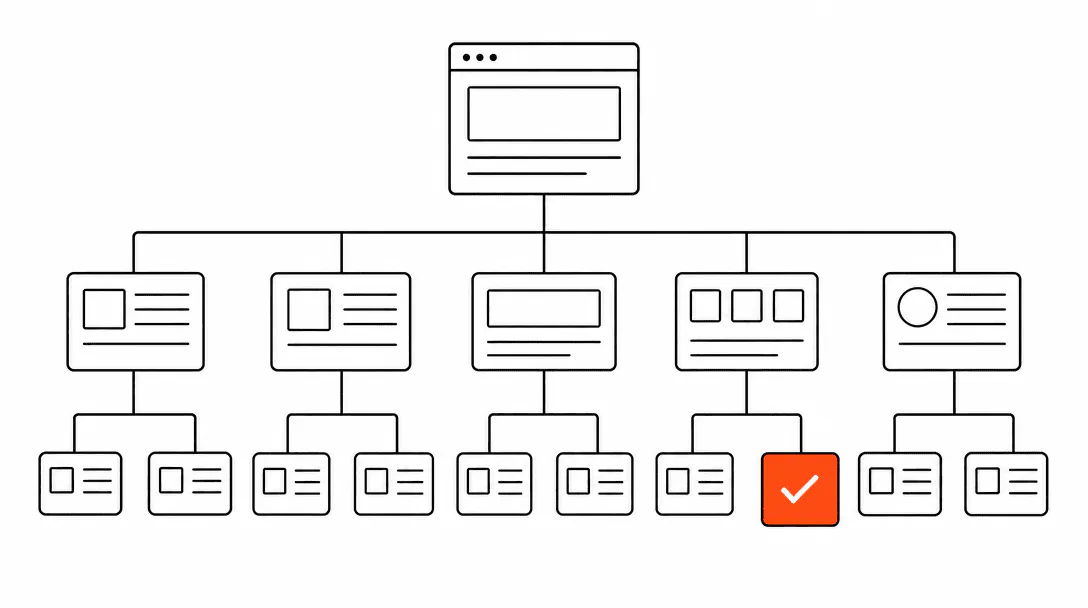
A service business website needs five pages at minimum: a homepage, a services page, an about page, a contact or booking page, and a dedicated service-area page. Most sites have four of those. The one that gets skipped most often is the service-area page, and that gap quietly costs map pack impressions every single month.
This post treats your site map as an operations spec. Every page here is described by the job it does in your lead flow, not just its name. If a page is not doing a job, it does not belong on your site. If a job is going undone, you are missing a page. This is part of the website foundation guide for service businesses building a site that works as a system.
What does a service business homepage actually need to do?
Your homepage has one job: answer three questions before a visitor scrolls. What do you do? Who do you serve? What should they do next? Everything else is decoration until those three questions are answered.
The headline carries most of that weight. "Jupiter pressure washing, done in a day" answers all three in nine words. A vague headline like "Quality Service You Can Trust" answers none of them. Visitors who cannot figure out what you do in the first three seconds leave, and on mobile they leave faster than that.
Below the headline, your homepage needs one clear call to action. Book a call, request a quote, or get an estimate, pick one and make it the obvious next step. Stacking four different buttons ("Call Us," "Email Us," "Get a Quote," "Learn More") splits attention and reduces the chance that any of them get clicked.
Social proof belongs on the homepage too, close to the top. A row of five-star review snippets, a count of jobs completed, or a few recognizable logos from the areas you serve all do the same job: they tell a first-time visitor that other people have hired you and were satisfied. That reassurance is what turns a browser into a lead. According to BrightLocal's 2025 consumer survey, 71% of consumers regularly read reviews before choosing a local business. If your homepage has no proof, you are asking visitors to take your word for it before they know anything about you.
of consumers regularly read reviews before choosing a local business.
What belongs on a services page?
A services page tells search engines and prospects exactly what you offer, described in the same language your customers use when they search for it. Each service should have its own section with a short description written in plain terms, the typical outcome ("leaves no streaks, same-day dry"), and a call to action pointing to your booking or contact page.
At launch, a single services page that lists all your offerings is fine. As your business grows, each distinct service warrants its own dedicated page. A roofing company offering roof replacement, roof repair, and gutter installation will get meaningfully more search coverage from three separate pages than from one combined page. Each page can target the specific phrase a homeowner types when they need that particular thing done.
The most common mistake on services pages is describing the process instead of the outcome. Customers do not buy processes; they buy results. "We use a soft-wash system at low pressure with biodegradable detergents" is a process. "Your roof will be clean and free of algae stains without any risk of shingle damage" is the outcome they are paying for. Write for the outcome first, then add the process detail for the customers who want it.
Why does an about page matter for a service business?
Your about page is the trust page. It exists to answer the question every prospect is quietly asking: are these people real, and are they someone I want inside my home or business?
A photo of the actual owner, a sentence about where you are based, and a short paragraph on how the business started will do more than three paragraphs of brand-speak about your "commitment to excellence." Real people trust real people. If your about page looks like it was written by a corporate committee, it is working against you.
For local service businesses, the about page is also where you can connect to the community. Mentioning the neighborhoods you grew up in, the local chamber you belong to, or the school your kids attend is not filler. It is a signal to a homeowner in the same area that you are part of the same community. That connection converts.
What should a contact or booking page do differently from just a phone number?
A dedicated contact or booking page captures leads when you are unavailable, which is most of the time outside business hours. A phone number on the homepage is useful. A page where someone can submit their name, service needed, and preferred timing means you wake up to a qualified inquiry in your inbox instead of a missed call that never leaves a voicemail.
The form should be short: name, phone or email, service type, and a message field. Every extra field reduces submission rates. If you want to qualify prospects further, you can do that with a follow-up call or text, but the goal of the form is to get the contact information, not to conduct the intake interview in writing.
This is also the right place to set response expectations. "We reply within two hours during business hours" tells the prospect they are not submitting into a void. That small detail improves form conversion because it removes the anxiety of not knowing if anyone will respond. For a deeper look at what happens after that form submits, read about why service businesses lose leads at the response stage.
Why does a service business need a dedicated service-area page?
A dedicated service-area page gives search engines and AI tools a structured, citable signal that you operate in a specific geography. Without it, your Google Business Profile and your website are not reinforcing each other, and you miss map pack impressions from nearby searches.
This is the page we see skipped most often, across every category we work in. When we add a service-area page and wire it correctly to the Google Business Profile, map pack impressions reliably climb in the weeks that follow. The page does not need to be long. It needs to clearly state the cities, towns, and zip codes you serve, include a sentence or two about each area that sounds like it was written by someone who actually works there, and link back to the services page.
Consider what happens without this page. A pressure washing company with a solid one-page scrolling site that shows a phone number and a gallery has a real problem: they get calls, but those calls come from one traffic source they cannot identify, and AI search tools have nothing structured to cite when someone asks "who does pressure washing near me." The service-area page solves both problems at once. It gives analytics something to track and it gives AI something to quote.
This connects directly to how customers find businesses today, where structured, location-specific content on your own domain carries real weight in both traditional and AI-powered search results.
Which additional pages are worth adding once the core five are in place?
Three pages move the needle most after the core five: individual service pages (one per service offering, as described above), a gallery or portfolio page, and a reviews or testimonials page.
The gallery page is often underestimated. For trade businesses especially, photos of before-and-after work are enormously persuasive. A homeowner deciding between two pressure washing companies will choose the one whose site shows ten stunning transformation photos over the one whose site describes the same results in text. The photos do not need professional photography; phone camera images taken in good light work fine.
A reviews or testimonials page collects social proof in one place. This is useful both for prospects who want to read more than the three snippets on the homepage and for search engines, which can parse structured review schema markup and use it to surface your business in relevant queries. Google explicitly supports LocalBusiness and Review schema, which means a properly marked-up reviews page is readable not just by people but by machines. That matters as AI-powered answers increasingly pull from structured data to answer "who is the best [service] near me" questions. For a practical walkthrough of getting more of those reviews to exist in the first place, read how to get more Google reviews.
What pages do service businesses often add that they should skip?
Skip the blog at launch unless you have a realistic plan to publish consistently. A blog with three posts from two years ago is worse than no blog. It signals inactivity to both visitors and search engines.
Skip a FAQ page as a standalone page. FAQs belong embedded on the relevant service or about page, where they answer questions in context. A separate FAQ page dilutes the structure of your site without adding a meaningful landing point for any search query.
Skip a separate "careers" page unless you are actively hiring. An empty page is a dead end, and it takes up navigation real estate that should be pointing visitors toward conversion.
The principle behind all three of those decisions is the same: every page on your site should have a job in the lead flow. If you cannot describe what a page does between "visitor arrives" and "visitor contacts you," that page is probably not earning its spot in your navigation.
How does your site structure affect AI search results?
Our web design service for service businesses is built around this exact site structure, with every page wired to do a specific job in the lead flow. If your goal is also showing up in local and AI search, that work runs through our visibility service.
AI search tools, including ChatGPT, Google's AI Overviews, and Perplexity, pull answers from structured, well-organized content. A site with clearly scoped pages is far easier for those tools to cite than a one-page scrolling site where all the information lives in a single file with no distinct headings or URLs.
When an AI tool gets a question like "what pressure washing companies serve [your city]," it looks for a page that directly answers that question. A service-area page with a city name in the title, the URL, and the first paragraph is structured to be cited. A one-page site with a vague footer mention of the same city is not.
This is not a distant concern for service businesses. AI Overviews now appear on a significant share of local service searches, and the businesses that get cited in those answers are the ones with structured, specific, location-scoped content on their own domains. Building the right pages is the foundation for showing up there.