
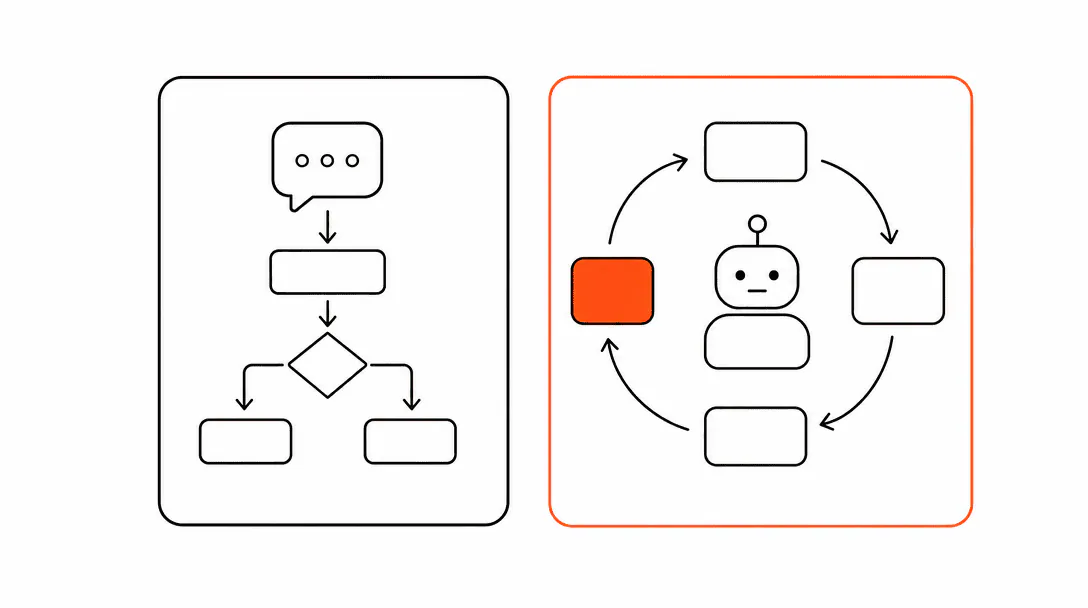
The quickest way to understand the difference: a chatbot is a FAQ page that talks. It reads from a fixed list of questions and answers, and when a visitor asks something outside that list, it apologizes and suggests calling the office. An agentic system is something else entirely. It reasons through what the person is asking, connects to your calendar and your CRM, and takes action, whether that means booking a job, adding a contact record, or routing an urgent inquiry to the right person on your team.
Both tools have "AI" in their marketing materials. That's where the similarity ends. Understanding the four real differences between them helps any service business owner choose the right tool and stop blaming the wrong one when it doesn't perform.
This post is part of the complete guide to agentic systems we've built for service business owners. If you're new to the topic, start there.
Does it follow a script, or does it reason through the conversation?
A chatbot follows a predetermined decision tree: if the visitor says X, show response Y. Anything that doesn't match a branch in the tree produces a fallback message. The system has no capacity to interpret intent, handle an unexpected phrasing, or adapt when the conversation takes a turn the designer didn't anticipate.
An agentic system reasons. It reads what the person actually said, figures out what they probably need, and decides what to do next based on that understanding. The conversation doesn't have to match a script. A homeowner who types "my roof started leaking after last night's storm, I need someone out here fast" gets a different response than someone asking for a quote for a new install, and the system handles both without a human being involved in routing the decision.
In practice, this matters the moment a conversation gets even slightly complex. A prospect who asks about pricing, then mentions they've had a bad experience with another contractor, then asks if you do evenings, has just given you three pieces of information that should shape your response. A chatbot handles one of those things, if it's been explicitly programmed for it. An agentic system can hold all three in context and respond accordingly.
Can it actually do anything, or just answer questions?
Chatbots are read-only. They present information. They can tell a visitor what your hours are, explain what services you offer, and point to a contact form. They cannot check whether Tuesday at 2 PM is available, create a lead in your pipeline, or send a confirmation text. When the conversation gets to the point of actually doing something, the chatbot hands off to a form, a link, or a phone call.
Agentic systems take action. They connect to live data sources and can write back to them. That means checking your actual calendar availability in real time, booking the appointment, adding the contact to your CRM with the relevant details from the conversation, and triggering whatever follow-up sequence you've set up, all without anyone on your team touching it.
A roofing company we work with had a chatbot on their site for almost two years. It answered questions about service areas and materials. Leads still had to fill out a form, wait for a call back, and schedule separately. The owner concluded that AI didn't work for their business. What didn't work was a read-only tool in a situation that required action. Once the intake moved to an agentic layer, prospects who came in after hours could get qualified, booked, and confirmed before the morning crew arrived.
Average time businesses take to respond to an inbound lead, according to a Harvard Business Review analysis. By the time that call comes, many prospects have already moved on.
Does it remember what was said earlier in the conversation?
Most chatbots are stateless: each message is treated independently, with no memory of what came before it. Ask a chatbot "do you do commercial jobs?" and get an answer. Then ask "what does that usually cost?" and the chatbot has no idea what "that" refers to. You've started over from zero.
Agentic systems maintain context across the entire conversation. The system remembers what the person said in their first message, what they clarified in their third, and what they asked about pricing. It uses all of that to give a response that actually makes sense given the full picture. A prospect who mentions they have a 3,000-square-foot home early in the conversation doesn't have to repeat it when the conversation turns to scoping the job.
Beyond the single conversation, some agentic systems can carry memory across sessions. If a returning client reaches out and the system recognizes them, it can reference their history, the job scope, who their assigned contact is, and any notes from previous interactions. That's the difference between feeling like you're talking to someone who knows your account and feeling like you're starting from scratch every time.
For an AI receptionist to work at the front desk of a service business, this kind of contextual memory is the baseline requirement. Without it, the conversation falls apart the moment the prospect deviates from the expected path.
Is it wired into your actual systems, or does it sit off to the side?
A chatbot is typically a widget sitting on your website with no connection to anything else in your operations. It doesn't know who's on your team, what your schedule looks like, which leads are already in your pipeline, or what your service area actually covers. It knows what it was programmed to say, nothing more.
An agentic system integrates with the tools you already use. Your calendar. Your CRM. Your job management platform. Depending on how it's built, it can pull from and write to all of them mid-conversation. When someone books through an agentic intake flow, the appointment lands in your calendar, the lead shows up in your CRM with the conversation context attached, and your team sees the job already scoped by the time they get to work in the morning.
Across the systems we've built for service businesses, the integration piece is where the real operational lift comes from. The booking capability alone is valuable, but when a new contact also creates a CRM record, tags the lead source, assigns it to a sales rep, and fires an onboarding sequence automatically, you've removed four or five manual steps from your intake process. That's not a marketing feature. That's an operations feature.
Understanding how AI agent CRM integration actually works is worth a dedicated read if you're evaluating vendors or thinking about what to build.
Which tool does your business actually need?
Chatbots are the right tool for one specific job: deflecting simple, repetitive questions at volume so your team doesn't have to answer them. If you run a service business that gets fifty emails a week asking what your hours are, whether you serve a certain zip code, and what your cancellation policy is, a chatbot handles all three without anyone lifting a finger. It's cheap, easy to set up, and it solves a narrow problem well.
The moment your goal shifts from answering questions to capturing leads, qualifying prospects, booking jobs, or following up automatically, you've moved outside what a chatbot can do. Those are active operations, not information delivery. They require a system that can reason, act, and integrate.
The clearest test: think about what happens when someone reaches your website at 10 PM on a Saturday and they want to book a job. With a chatbot, they read some information and fill out a form they may or may not come back to. With an agentic system, they have a conversation, get qualified, see available times, choose one, and receive a confirmation. The job is booked. Your competitor who only has a chatbot is hoping that person fills out the form and waits. That booking capability is exactly what a properly built service website is designed to support.
Running one AI agent across web, text, and phone is how businesses close that gap completely, covering every channel a prospect might use to reach out.
What agentic systems are not
Worth naming directly, because the marketing around AI tools creates confusion: agentic systems are not magic, and they are not one-size-fits-all. A poorly built agentic system that gives wrong information about your services, misbooks appointments, or fails to hand off urgent situations to a human is worse than no system at all. The capability is real; the execution determines whether it actually helps.
They also are not fully autonomous replacements for your team. The right mental model is a capable first contact who handles intake, qualification, and booking, and knows exactly when to bring a human in. For nuanced situations, for complaints, for anything that requires real judgment about a complex job, the system should route to a person. The distinction between AI agents and automation helps clarify where each type of tool fits in a broader operations picture.
The businesses that get the most from agentic systems treat them as a layer in their operations stack, not a replacement for it. The AI handles the repeatable, time-sensitive first contact. Your team handles the work that benefits from human attention. Both do what they're best at. See how the full stack fits together on the get automated page, or explore the full capabilities overview to understand what is possible across web, search, and AI systems.
Of small businesses using generative AI report measurable efficiency gains, according to the OECD. The gains concentrate most in intake and communication workflows.
How to figure out which one you have right now
Test your current tool with three scenarios. First, ask it something slightly off-script: not a question from its FAQ, but something a real prospect would actually say. Does it give a coherent, useful response? Second, ask it to book something. Does it check real availability and actually create an appointment? Third, ask a follow-up that references something you said two messages ago. Does it remember?
If it fails all three, you have a chatbot. That's not a problem if all you wanted was FAQ deflection. It's a significant gap if you expected it to handle intake and booking.
The owners who feel burned by AI almost always ran this experiment informally, watched the chatbot fail, and concluded that AI as a category doesn't work for service businesses. The tool failed, not the category. The distinction matters because the decision about whether to invest in an agentic system should be made with accurate information, not based on a chatbot's limitations.